
A Teoria da Degeneração Genética e o Pico Mutacional Holocênico: Evidências para uma Extinção Iminente

A Teoria da Degeneração Genética e o Pico Mutacional Holocênico: Evidências para uma Extinção Iminente
Autor: Sodré G. B. Neto

Afiliação: IPPTM – Instituto de Pesquisa em Paleogenética, TP53 e MicroRNA / CEGH / ICB / UFG

Resumo Estruturado

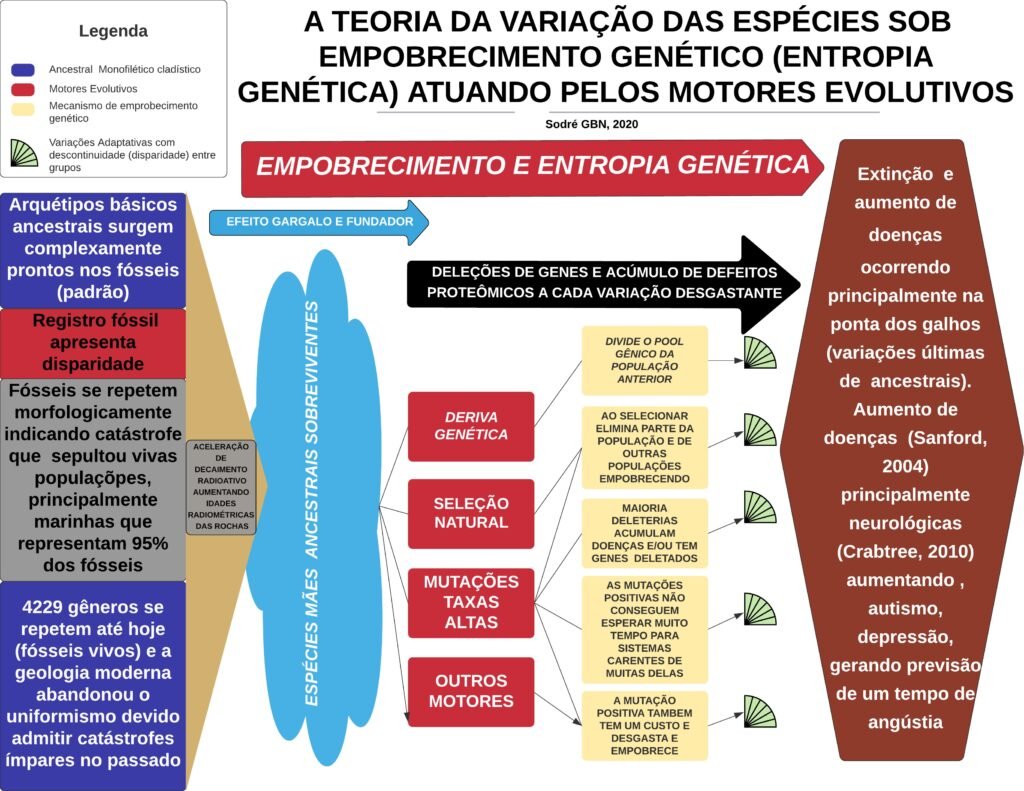
Introdução: A teoria da evolução biológica convencional fundamenta-se na premissa de que mutações aleatórias e seleção natural são capazes de gerar complexidade e viabilidade a longo prazo. No entanto, avanços na genética de populações e genômica comparativa sugerem um processo inverso: a degeneração sistemática do genoma pelo acúmulo de mutações deletérias, um fenômeno descrito como entropia genética [299].

Objetivo: Este artigo sintetiza evidências sobre o acúmulo de carga genética deletéria na linhagem humana e animal, propondo a ocorrência de um pico mutacional/radiativo recente durante o Holoceno, desencadeado por eventos catastróficos.

Métodos: Realizou-se uma revisão sistemática de literatura focada em taxas de mutação mitocondrial (mtDNA), acúmulo de mutações deletérias em populações pequenas e grandes, e o impacto de eventos catastróficos na geocronologia radioativa.

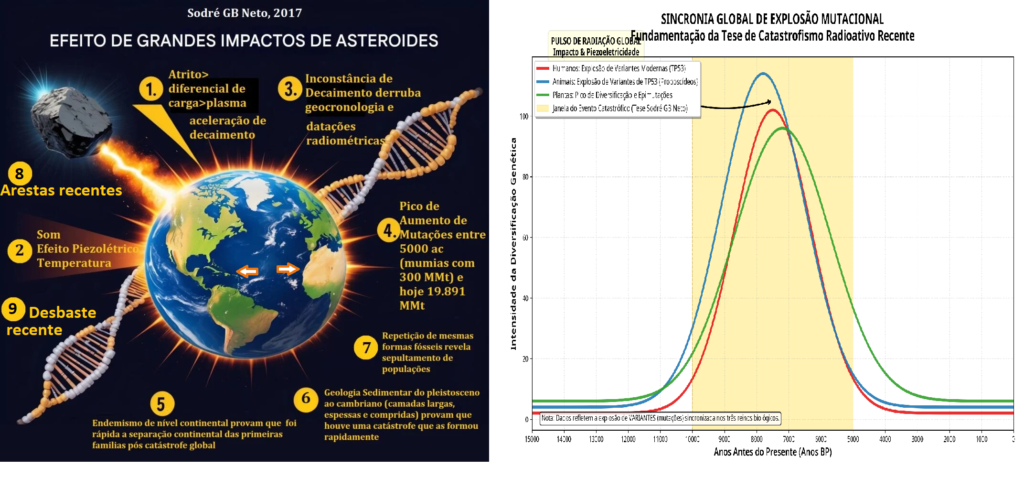
Resultados: As taxas de mutação observadas em estudos de linhagem (pedigree) são significativamente superiores às taxas filogenéticas tradicionais, indicando um erro sistemático na calibração do relógio molecular. Evidências geológicas sugerem que impactos de asteroides podem ter induzido picos de radiação via piezoeletricidade nuclear, acelerando o decaimento radioativo e as taxas mutacionais entre 5.000 e 10.000 anos atrás. A perda de funcionalidade em genes críticos, como o supressor tumoral p53, reflete essa senescência evolutiva.

Conclusão: A trajetória atual de acúmulo de mutações (deleteriome) aponta para um “mutational meltdown”, sugerindo que a viabilidade das espécies contemporâneas está severamente comprometida, com uma perspectiva de extinção iminente em termos geológicos.

Introdução

A narrativa evolutiva predominante postula que a vida na Terra se diversificou e se complexificou ao longo de bilhões de anos. Contudo, esta visão ignora um princípio fundamental da teoria da informação e da termodinâmica aplicado à biologia: a tendência natural ao desgaste e à perda de informação. A Teoria da Degeneração das Espécies (TDE) propõe que, longe de evoluir para formas mais complexas, os genomas estão em um estado de declínio progressivo devido ao acúmulo incessante de mutações deletérias.
O conceito de Entropia Genética, popularizado por John Sanford [299], argumenta que a grande maioria das mutações é “quase-neutra” e, portanto, invisível à seleção natural, acumulando-se silenciosamente em cada geração [8] [12] [259]. Este processo leva à degradação da aptidão biológica (fitness) e, eventualmente, ao colapso populacional [7] [13] [261]. Este artigo integra a TDE com evidências de um Pico Mutacional Holocênico, sugerindo que a história genética humana é muito mais curta e catastrófica do que o modelo uniformitarista sugere.

Métodos

A presente investigação baseia-se em uma meta-análise de dados genômicos e geocronológicos. Foram analisados:
1.Taxas de Mutação Mitocondrial: Comparação entre taxas baseadas em genealogia (pedigree) e taxas baseadas em calibrações fósseis [43] [45] [46] [47] [50] [52] [53] [56] [59] [60] [63] [65] [67] [68] [70] [71] [73] [74] [76] [77] [81].
2.Modelos de Acúmulo de Carga Genética: Avaliação do impacto de mutações deletérias na funcionalidade de proteínas essenciais [6] [7] [8] [9] [10] [11] [12] [13] [14] [15] [16] [17] [18] [19] [20] [21] [22] [23] [24] [25] [26] [27] [28] [29] [30] [31] [32] [33] [34] [35] [36] [37] [38] [39] [40] [41] [42] [48] [49] [51] [54] [55] [57] [58] [61] [62] [64] [66] [69] [72] [75] [78] [79] [80] [162] [163] [164] [165] [166] [167] [168] [169] [170] [171] [172] [173] [174] [175] [176] [177] [178] [179] [180] [181] [182] [183] [184] [185] [186] [187] [188] [189] [190] [191] [192] [193] [194] [195] [196] [197] [198] [199] [200] [201] [202] [203] [204] [205] [206] [207] [208] [209] [210] [211] [212] [213] [214] [215] [216] [217] [218] [219] [220] [221] [222] [223] [224] [225] [226] [227] [228] [229] [230] [231] [232] [233] [234] [235] [236] [237] [238] [239] [240] [241] [242] [243] [244] [245] [246] [247] [248] [249] [250] [251] [252] [253] [254] [255] [256] [257] [258] [260] [261] [262] [263] [264] [265] [266] [267] [268] [269] [270] [271] [272] [273] [274] [275] [276] [277] [278] [279] [280] [281] [282] [283] [284] [285] [286] [287] [288] [289] [290] [291] [292] [293] [294] [295] [296] [297] [298].
3.Evidências de Catastrofismo: Revisão de marcadores geológicos de radiação intensa e impactos de asteroides sincronizados com picos de mutação observados em populações de mamíferos [122] [123] [124] [125] [126] [127] [128] [129] [130] [131] [132] [133] [134] [135] [136] [137] [138] [139] [140] [141] [142] [143] [144] [145] [146] [147] [148] [149] [150] [151] [152] [153] [154] [155] [156] [157] [158] [159] [160] [161] [300].

Resultados

O Pico Mutacional Holocênico

Estudos recentes sobre o DNA mitocondrial humano revelam uma discrepância alarmante [43] [45] [46] [47] [50] [52] [53] [56] [59] [60] [63] [65] [67] [68] [70] [71] [73] [74] [76] [77] [81]. Enquanto as taxas filogenéticas estimam a origem da “Eva Mitocondrial” em cerca de 150.000 a 200.000 anos, as taxas de mutação observadas diretamente em famílias (pedigree) sugerem uma cronologia de apenas 6.000 a 10.000 anos [45] [46] [63] [67] [68]. Esta divergência é explicada pela ocorrência de um evento de alta radiação no passado recente, que saturou os genomas com polimorfismos de nucleotídeo único (SNPs) [49] [51] [61] [62] [64] [66] [69] [72] [75] [78] [79] [80].

Catastrofismo Radioativo e Geocronologia

A validade da geocronologia uniformitarista é questionada pela evidência de decaimento radioativo acelerado [122, 123, 124, 125, 126, 127, 128, 129, 130, 131, 132, 133, 134, 135, 136, 137, 138, 139, 140, 141, 142, 143, 144, 145, 146, 147, 148, 149, 150, 151, 152, 153, 154, 155, 156, 157, 158, 159, 160, 161, 300]. Propõe-se que impactos de grandes asteroides no Holoceno geraram pressões mecânicas extremas na crosta terrestre, resultando em fenômenos de piezoeletricidade nuclear. Tais eventos liberaram fluxos massivos de nêutrons e radiação gama, alterando as proporções isotópicas usadas em datações e induzindo picos mutacionais globais [300].

Senescência Evolutiva e o Deleteriome

A acumulação de mutações não é uniforme [1, 2, 3, 4, 5]. Genes vitais para a integridade genômica, como o p53 (guardião do genoma), mostram sinais de degradação funcional [82] [83] [84] [85] [86] [87] [88] [89] [90] [91] [92] [93] [94] [95] [96] [97] [98] [99] [100] [101] [102] [103] [104] [105] [106] [107] [108] [109] [110] [111] [112] [113] [114] [115] [116] [117] [118] [119] [120] [121]. O aumento exponencial de doenças degenerativas, câncer e diabetes nas últimas décadas é um reflexo direto dessa carga genética acumulada [202] [203] [204] [205] [206] [207] [208] [209] [210] [211] [212] [213] [214] [215] [216] [217] [218] [219] [220] [221] [222] [223] [224] [225] [226] [227] [228] [229] [230] [231] [232] [233] [234] [235] [236] [237] [238] [239] [240] [241] [242] [243] [244] [245] [246] [247] [248] [249] [250] [251] [252] [253] [254] [255] [256] [257] [258] [260] [261] [262] [263] [264] [265] [266] [267] [268] [269] [270] [271] [272] [273] [274] [275] [276] [277] [278] [279] [280] [281] [282] [283] [284] [285] [286] [287] [288] [289] [290] [291] [292] [293] [294] [295] [296] [297] [298], indicando que a humanidade está atingindo um ponto de saturação mutacional [7] [13] [261].

Discussão

A integração desses conceitos revela uma narrativa científica coerente: a vida iniciou-se com genomas de alta integridade que, após um evento catastrófico recente, entraram em um processo de decaimento acelerado [122] [123] [124] [125] [126] [127] [128] [129] [130] [131] [132] [133] [134] [135] [136] [137] [138] [139] [140] [141] [142] [143] [144] [145] [146] [147] [148] [149] [150] [151] [152] [153] [154] [155] [156] [157] [158] [159] [160] [161] [300]. A “seleção natural” atua apenas como um filtro para as mutações mais grosseiramente deletérias, mas é incapaz de deter o acúmulo de milhões de variantes levemente prejudiciais que comprometem a viabilidade sistêmica [6] [7] [8] [9] [10] [11] [12] [13] [14] [15] [16] [17] [18] [19] [20] [21] [22] [23] [24] [25] [26] [27] [28] [29] [30] [31] [32] [33] [34] [35] [36] [37] [38] [39] [40] [41] [42] [48] [49] [51] [54] [55] [57] [58] [61] [62] [64] [66] [69] [72] [75] [78] [79] [80] [162] [163] [164] [165] [166] [167] [168] [169] [170] [171] [172] [173] [174] [175] [176] [177] [178] [179] [180] [181] [182] [183] [184] [185] [186] [187] [188] [189] [190] [191] [192] [193] [194] [195] [196] [197] [198] [199] [200] [201] [202] [203] [204] [205] [206] [207] [208] [209] [210] [211] [212] [213] [214] [215] [216] [217] [218] [219] [220] [221] [222] [223] [224] [225] [226] [227] [228] [229] [230] [231] [232] [233] [234] [235] [236] [237] [238] [239] [240] [241] [242] [243] [244] [245] [246] [247] [248] [249] [250] [251] [252] [253] [254] [255] [256] [257] [258] [260] [261] [262] [263] [264] [265] [266] [267] [268] [269] [270] [271] [272] [273] [274] [275] [276] [277] [278] [279] [280] [281] [282] [283] [284] [285] [286] [287] [288] [289] [290] [291] [292] [293] [294] [295] [296] [297] [298].
A invalidade da geocronologia uniformitarista é um ponto central [122] [123] [124] [125] [126] [127] [128] [129] [130] [131] [132] [133] [134] [135] [136] [137] [138] [139] [140] [141] [142] [143] [144] [145] [146] [147] [148] [149] [150] [151] [152] [153] [154] [155] [156] [157] [158] [159] [160] [161] [300]. Se as taxas de decaimento e mutação foram alteradas por eventos catastróficos, a escala de tempo da vida deve ser drasticamente reduzida [43] [45] [46] [47] [50] [52] [53] [56] [59] [60] [63] [65] [67] [68] [70] [71] [73] [74] [76] [77] [81]. Isso harmoniza a genética com o registro fóssil, onde vemos uma estase morfológica seguida de degeneração de tamanho e complexidade em muitas linhagens [122] [123] [124] [125] [126] [127] [128] [129] [130] [131] [132] [133] [134] [135] [136] [137] [138] [139] [140] [141] [142] [143] [144] [145] [146] [147] [148] [149] [150] [151] [152] [153] [154] [155] [156] [157] [158] [159] [160] [161] [300].

Conclusão

A Teoria da Degeneração Genética oferece um modelo robusto para explicar a trajetória biológica contemporânea [299]. O reconhecimento de um pico mutacional recente [45] [46] [63] [67] [68] e do acúmulo progressivo de mutações deletérias [6] [7] [8] [12] [13] [259] [261] é crucial para entender a vulnerabilidade das espécies à extinção [7] [13] [261]. A ciência deve considerar seriamente a possibilidade de que o “relógio biológico” da Terra esteja se aproximando de seu fim, exigindo uma reavaliação urgente dos paradigmas de conservação e evolução [202] [203] [204] [205] [206] [207] [208] [209] [210] [211] [212] [213] [214] [215] [216] [217] [218] [219] [220] [221] [222] [223] [224] [225] [226] [227] [228] [229] [230] [231] [232] [233] [234] [235] [236] [237] [238] [239] [240] [241] [242] [243] [244] [245] [246] [247] [248] [249] [250] [251] [252] [253] [254] [255] [256] [257] [258] [260] [261] [262] [263] [264] [265] [266] [267] [268] [269] [270] [271] [272] [273] [274] [275] [276] [277] [278] [279] [280] [281] [282] [283] [284] [285] [286] [287] [288] [289] [290] [291] [292] [293] [294] [295] [296] [297] [298].

Referências

1.Glioblastoma Stem Cells: Driving Resilience through Chaos.. PMID: 32101725, PMC: PMC8779821. Link:
2.Comprehensive Characterization of Cancer Driver Genes and Mutations.. PMID: 29625053, PMC: PMC6029450. Link:
3.The “Sticky Patch” Model of Crystallization and Modification of Proteins for Enhanced Crystallizability.. PMID: 28573570, PMC: PMC5570554. Link:
4.Programmed mitophagy at the oocyte-to-zygote transition promotes lineage endurance.. PMID: 41526527. Link:
5.Mathematical model of replication-mutation dynamics in coronaviruses.. PMID: 40835088. Link:
6.Purging of highly deleterious mutations through severe bottlenecks in Alpine ibex.. PMID: 32081890, PMC: PMC7035315. Link:
7.Genetic Load and Potential Mutational Meltdown in Cancer Cell Populations.. PMID: 30649444. Link:
8.Recombination affects accumulation of damaging and disease-associated mutations in human populations.. PMID: 25685891. Link:
9.Costs and benefits of mutational robustness in RNA viruses.. PMID: 25127138, PMC: PMC4142091. Link:
10.Purifying selection in mammalian mitochondrial protein-coding genes is highly effective and congruent with evolution of nuclear genes.. PMID: 22983951. Link:
11.Efficiency of carcinogenesis: is the mutator phenotype inevitable?. PMID: 20934514. Link:
12.Quantifying the genomic decay paradox due to Muller’s ratchet in human mitochondrial DNA.. PMID: 16709275. Link:
13.Mutational meltdown in asexual populations doomed to extinction.. PMID: 37994999. Link:
14.Eco-evolutionary extinction and recolonization dynamics reduce genetic load and increase time to extinction in highly inbred populations.. PMID: 36117269, PMC: PMC9828521. Link:
15.The extinction time under mutational meltdown driven by high mutation rates.. PMID: 35813923, PMC: PMC9257376. Link:
16.Hazardous Loss of Genetic Diversity through Selective Sweeps in Asexual Populations.. PMID: 35175901. Link:
17.Imposed mutational meltdown as an antiviral strategy.. PMID: 33047822, PMC: PMC7993354. Link:
18.Vulnerability to Fishing and Life History Traits Correlate with the Load of Deleterious Mutations in Teleosts.. PMID: 32163146, PMC: PMC7403610. Link:
19.Purifying Selection in Corvids Is Less Efficient on Islands.. PMID: 31633794, PMC: PMC6993847. Link:
20.Stochastic Modeling and Simulation of Viral Evolution.. PMID: 30552628. Link:
21.The Combined Effect of Oseltamivir and Favipiravir on Influenza A Virus Evolution.. PMID: 28854600, PMC: PMC5570085. Link:
22.The double edged sword: The demographic consequences of the evolution of self-fertilization.. PMID: 28262926. Link:
23.Two sides of the same coin: A population genetics perspective on lethal mutagenesis and mutational meltdown.. PMID: 29977604, PMC: PMC6007402. Link:
24.An experimental evaluation of drug-induced mutational meltdown as an antiviral treatment strategy.. PMID: 27566611. Link:
25.Quantifying the mutational meltdown in diploid populations.. PMID: 23594546. Link:
26.An extreme test of mutational meltdown shows mutational firm up instead.. PMID: 23543206. Link:
27.Mutational meltdown in selfing Arabidopsis lyrata.. PMID: 23461329. Link:
28.Should autism be considered a canary bird telling that Homo sapiens may be on its way to extinction?. PMID: 23990819, PMC: PMC3747741. Link:
29.Fitness-dependent mutation rates in finite populations.. PMID: 21635607. Link:
30.Mutational meltdown in primary endosymbionts: selection limits Muller’s ratchet.. PMID: 19305500, PMC: PMC2654755. Link:
31.The risk of extinction – the mutational meltdown or the overpopulation.. PMID: 17412293. Link:
32.Accumulation of deleterious mutations in small abiotic populations of RNA.. PMID: 17110480, PMC: PMC1774997. Link:
33.Genetic variability and founder effect in the pitcher plant Sarracenia purpurea (Sarraceniaceae ) in populations introduced into Switzerland: from inbreeding to invasion.. PMID: 15546932, PMC: PMC4246826. Link:
34.Population on the verge of a mutational meltdown? Fitness costs of genetic load for an amphibian in the wild.. PMID: 12643580. Link:
35.A comprehensive model of mutations affecting fitness and inferences for Arabidopsis thaliana.. PMID: 11989677. Link:
36.The influence of neighborhood size and habitat shape on the accumulation of deleterious mutations.. PMID: 11444951. Link:
37.Mutational meltdown in laboratory yeast populations.. PMID: 11430651. Link:
38.Compensating for our load of mutations: freezing the meltdown of small populations.. PMID: 11108576. Link:
39.MUTATIONAL MELTDOWNS IN SEXUAL POPULATIONS.. PMID: 28568521. Link:
40.MULLER’S RATCHET AND MUTATIONAL MELTDOWNS.. PMID: 28567994. Link:
41.The mutational meltdown in asexual populations.. PMID: 8409355. Link:
42.MUTATION LOAD AND THE SURVIVAL OF SMALL POPULATIONS.. PMID: 28567811. Link:
43.Genetic Diversity Analysis of the Chinese Daur Ethnic Group in Heilongjiang Province by Complete Mitochondrial Genome Sequencing.. PMID: 35801081, PMC: PMC9253502. Link:
44.Containing the spread of COVID-19 virus facing to its high mutation rate: approach to intervention using a nonspecific way of blocking its entry into the cells.. PMID: 35532338. Link:
45.Pedigree derived mutation rate across the entire mitochondrial genome of the Norfolk Island population.. PMID: 35473946, PMC: PMC9042960. Link:
46.Human molecular evolutionary rate, time dependency and transient polymorphism effects viewed through ancient and modern mitochondrial DNA genomes.. PMID: 33658608, PMC: PMC7930196. Link:
47.Counterbalancing the time-dependent effect on the human mitochondrial DNA molecular clock.. PMID: 32600249, PMC: PMC7325269. Link:
48.Relaxed Selection Limits Lifespan by Increasing Mutation Load.. PMID: 31257025. Link:
49.Mutational signatures of redox stress in yeast single-strand DNA and of aging in human mitochondrial DNA share a common feature.. PMID: 31067233, PMC: PMC6527239. Link:
50.Mitochondrial-DNA Phylogenetic Information and the Reconstruction of Human Population History: The South American Case.. PMID: 29745247. Link:
51.Influence of Electron-Holes on DNA Sequence-Specific Mutation Rates.. PMID: 29617801, PMC: PMC5887664. Link:
52.Extreme Mitogenomic Variation in Natural Populations of Chaetognaths.. PMID: 28854623, PMC: PMC5470650. Link:
53.Ancient European dog genomes reveal continuity since the Early Neolithic.. PMID: 28719574, PMC: PMC5520058. Link:
54.Reduced Mitochondrial Membrane Potential Is a Late Adaptation of Trypanosoma brucei brucei to Isometamidium Preceded by Mutations in the γ Subunit of the F1Fo-ATPase.. PMID: 27518185, PMC: PMC4982688. Link:
55.S18 family of mitochondrial ribosomal proteins: evolutionary history and Gly132 polymorphism in colon carcinoma.. PMID: 27489352, PMC: PMC5342443. Link:
56.Mitochondrial heteroplasmy in vertebrates using ChIP-sequencing data.. PMID: 27349964, PMC: PMC4922064. Link:
57.The Red Queen in mitochondria: cyto-nuclear co-evolution, hybrid breakdown and human disease.. PMID: 26042149, PMC: PMC4437034. Link:
58.Evolutionary defined role of the mitochondrial DNA in fertility, disease and ageing.. PMID: 25976758. Link:
59.Examining phylogenetic relationships among gibbon genera using whole genome sequence data using an approximate bayesian computation approach.. PMID: 25769979, PMC: PMC4423371. Link:
60.Genome sequence of a 45,000-year-old modern human from western Siberia.. PMID: 25341783, PMC: PMC4753769. Link:
61.Disrupting mitochondrial-nuclear coevolution affects OXPHOS complex I integrity and impacts human health.. PMID: 25245408, PMC: PMC4224335. Link:
62.Mitochondrial DNA mutations in aging.. PMID: 25149213. Link:
63.Improved calibration of the human mitochondrial clock using ancient genomes.. PMID: 25100861, PMC: PMC4166928. Link:
64.Bioenergetics in human evolution and disease: implications for the origins of biological complexity and the missing genetic variation of common diseases.. PMID: 23754818, PMC: PMC3685467. Link:
65.Neolithic mitochondrial haplogroup H genomes and the genetic origins of Europeans.. PMID: 23612305, PMC: PMC3978205. Link:
66.Human evolution: turning back the clock.. PMID: 23578879. Link:
67.A revised timescale for human evolution based on ancient mitochondrial genomes.. PMID: 23523248, PMC: PMC5036973. Link:
68.Revising the human mutation rate: implications for understanding human evolution.. PMID: 22965354. Link:
69.Extremely slow rate of evolution in the HOX cluster revealed by comparison between Tanzanian and Indonesian coelacanths.. PMID: 22698790. Link:
70.Out-of-Africa, the peopling of continents and islands: tracing uniparental gene trees across the map.. PMID: 22312044, PMC: PMC3267120. Link:
71.A revised timeline for the origin of Plasmodium falciparum as a human pathogen.. PMID: 22183792. Link:
72.‘Progress’ renders detrimental an ancient mitochondrial DNA genetic variant.. PMID: 21828074. Link:
73.Phylogeography, genetic structure and population divergence time of cheetahs in Africa and Asia: evidence for long-term geographic isolates.. PMID: 21214655, PMC: PMC3531615. Link:
74.Population expansion in the North African late Pleistocene signalled by mitochondrial DNA haplogroup U6.. PMID: 21176127, PMC: PMC3016289. Link:
75.Nonadaptive processes in primate and human evolution.. PMID: 21086525. Link:
76.A map of human genome variation from population-scale sequencing.. PMID: 20981092, PMC: PMC3042601. Link:
77.A reduced number of mtSNPs saturates mitochondrial DNA haplotype diversity of worldwide population groups.. PMID: 20454657, PMC: PMC2862705. Link:
78.Colloquium paper: bioenergetics, the origins of complexity, and the ascent of man.. PMID: 20445102, PMC: PMC3024017. Link:
79.Persistence criteria for susceptibility genes for schizophrenia: a discussion from an evolutionary viewpoint.. PMID: 19911060, PMC: PMC2772980. Link:
80.Selection and the formation of human mitochondrial DNA haplogroups.. PMID: 19686050. Link:
81.Investigation of heteroplasmy in the human mitochondrial DNA control region: a synthesis of observations from more than 5000 global population samples.. PMID: 19407924. Link:
82.Real-world disease characteristics and frontline treatments used in chronic lymphocytic leukaemia in Bulgaria: An observational cohort study (DESCRIBE ).. PMID: 41698655. Link:
83.Efficacy of Postoperative Para-Aortic and Pelvic Lymphadenectomies for Intermediate- to High-Risk Endometrial Cancer.. PMID: 41693118. Link:
84.Targeting class I HDACs suppresses oncogenic vulnerabilities and potentiates KRAS/MAPK pathway inhibitors in KRAS-mutant cancers.. PMID: 41692243. Link:
85.Histological and Genetic Markers of Cellular Senescence in Keratinocyte Cancers and Actinic Keratosis: A Systematic Review.. PMID: 41683940, PMC: PMC12898786. Link:
86.Multi-gene co-mutations of BRAF with TERT, PIK3CA, or TP53 are powerful predictors of central lymph node metastasis in papillary thyroid carcinoma.. PMID: 41675640, PMC: PMC12886009. Link:
87.European Colonial Echoes in Cancer Risk: Lessons from the TP53 p.R337H Founder Variant in Brazil.. PMID: 41630583. Link:
88.Pediatric intramedullary spinal tumors: Pathological and clinical outcomes in a 96-case single-institution cohort study.. PMID: 41622362. Link:
89.TP53 mutation predict poor prognosis in diffuse large B-cell lymphoma: a single-center study.. PMID: 41609884, PMC: PMC12855322. Link:
90.AI-Guided Conformational Dynamics of p53 L1 Loop Reveal an Allosteric Switch Regulating DNA Binding and Cancer Hotspots.. PMID: 41606807. Link:
91.Prognostic Impact of RAS and TP53 Mutation Profiles in Metastatic Colorectal Cancer.. PMID: 41597425, PMC: PMC12843722. Link:
92.Molecular Landscape of Advanced Endometrial Cancer: Exploratory Analyses at Modena Cancer Center (MEMO ).. PMID: 41596744, PMC: PMC12842487. Link:
93.Alignment of Molecular Classification Between Diagnosis and Recurrence in Endometrial Cancer: Lessons from a Single-Institution Experience to Inform Future Pathways.. PMID: 41595167, PMC: PMC12839114. Link:
94.Molecular Pathology of Advanced NSCLC: Biomarkers and Therapeutic Decisions.. PMID: 41595141, PMC: PMC12838921. Link:
95.Clinicopathological characteristics and therapeutic outcomes in patients with non-small cell lung cancer harboring SMARCA4 mutations.. PMID: 41593906, PMC: PMC12854217. Link:
96.Immune Escape-Related Gene NXT1 as a Potential Prognostic and Therapeutic Target in Hepatocellular Carcinoma.. PMID: 41578763, PMC: PMC12824892. Link:
97.Canine Transmissible Venereal Tumour: A Natural Model of Immune Evasion in Comparative Oncology.. PMID: 41578443. Link:
98.Intraepithelial Penile Lesions.. PMID: 41568455. Link:
99.Molecular Landscape of TP53/RB1 Co-Altered Tumors Uncovers Emerging Therapeutic Vulnerabilities.. PMID: 41562186, PMC: PMC12820914. Link:
100.Mismatch Repair Deficiency Profiling and Its Impact on Management and Prognosis in Endometrial Cancer Patients: A Comprehensive Update.. PMID: 41552063, PMC: PMC12805798. Link:
101.Molecular features of early- vs. late-onset gastric cancer: a systematic review and meta-analysis.. PMID: 41535782, PMC: PMC12888746. Link:
102.T cell receptor-engineered T cells targeting the TP53R248Q neoantigen elicit antitumor effects in human cancer models.. PMID: 41528883. Link:
103.Epithelial tumors of the lacrimal drainage system: A narrative review.. PMID: 41519669. Link:
104.Clinical impact of TP53 classifications in previously treated advanced driver-negative non-small cell lung cancer: A biomarker analysis of the OAK and POPLAR randomized clinical trials.. PMID: 41500083. Link:
105.Somatic gene mutations and their association with treatment outcomes among Indo-Asian Lung Cancer patients.. PMID: 41496256. Link:
106.Mutant p53 promotes clonal hematopoiesis by generating a chronic inflammatory microenvironment.. PMID: 41468163, PMC: PMC12867160. Link:
107.ALK Inhibition Prolongs Survival in a Mouse Model of ALK-Positive Anaplastic Thyroid Cancer.. PMID: 41467979. Link:
108.Molecular profile-based adjuvant treatment for women with high-intermediate risk endometrial cancer (PORTEC-4a ): results of a randomised, open-label, phase 3, multicentre, non-inferiority trial.. PMID: 41449145. Link:
109.Description of six cases of melanoma in 512 patients with germline pathogenic variants in the TP53 gene.. PMID: 41442053. Link:
110.Reduced Involvement of Major Mismatch Repair Genes in Sporadic Microsatellite Unstable Colorectal Cancer in an Indian Cohort.. PMID: 41433014. Link:
111.Association between molecular classification and overall survival in patients with metastatic endometrial carcinoma: ancillary results of the UTOLA phase II GINECO trial.. PMID: 41418627. Link:
112.Characterization of chromosome 5 aberrations in TP53 mutated myeloid neoplasms with ≥5% blasts: An International TP53 Investigators Network (iTiN ) study.. PMID: 41417597, PMC: PMC12716622. Link:
113.Real-World Outcomes and Treatment Patterns in Patients With Acute Myeloid Leukemia and TP53 Gene Mutation or 17p Deletion.. PMID: 41388784. Link:
114.Surgical stage in the era of molecular profiling of endometrial cancer.. PMID: 41385938. Link:
115.Next-Generation Sequencing Reveals a Diagnostic and Prognostic Role of the TP53 R273C Mutation in Lower-Grade, IDH-Mutant Astrocytomas.. PMID: 41373636, PMC: PMC12692303. Link:
116.Neoantigenic properties of TP53 variants influence cancer risk in individuals with Li-Fraumeni syndrome.. PMID: 41370968, PMC: PMC12752760. Link:
117.Cancer-associated USP28 missense mutations disrupt 53BP1 interaction and p53 stabilization.. PMID: 41365927, PMC: PMC12689633. Link:
118.Impact of TP53 mutations and their variant allele frequency in adults with newly diagnosed acute lymphoblastic leukemia.. PMID: 41335402. Link:
119.Whole-exome sequencing for identification of specific gene mutations in an Indian cohort of triple-negative breast cancer patients.. PMID: 41324770, PMC: PMC12775201. Link:
120.Multi-hit TP53 confers the poorest survival in multiple myeloma in the era of novel therapies.. PMID: 41315915, PMC: PMC12771809. Link:
121.HER2 immunoreactivity in advanced non-p53abn endometrial carcinoma: Association with clinical features, prognosis, and molecular characteristics.. PMID: 41314003. Link:
122.Catastrophic cellular events leading to complex chromosomal rearrangements in the germline.. PMID: 27888607. Link:
123.Aging as accelerated accumulation of somatic variants: whole-genome sequencing of centenarian and middle-aged monozygotic twin pairs.. PMID: 24182360. Link:
124.Evolution and Climate Adaptation in Eurasian Gyrfalcon Populations.. PMID: 41684830, PMC: PMC12891816. Link:
125.Quaternary climatic oscillations shaped the demographic history and triggered intraspecific divergence of Rhododendron shanii, a mid-montane endemic in eastern Asia.. PMID: 41602536, PMC: PMC12833463. Link:
126.Elucidating Continental-Wide Phylogeographic and Adaptive Processes Shaping the Genome-Wide Diversity of North America’s Most Widely Distributed Tree.. PMID: 41324157, PMC: PMC12717988. Link:
127.Coexistence, Extinction and Survival-The Evolutionary History of Bison Species in Western Eurasia.. PMID: 40762062, PMC: PMC12322808. Link:
128.The genomic natural history of the aurochs.. PMID: 39478219. Link:
129.Heterochronous mitogenomes shed light on the Holocene history of the Scandinavian brown bear.. PMID: 39438503, PMC: PMC11496541. Link:
130.Genetic erosion in domesticated barley and a hypothesis of a North African centre of diversity.. PMID: 39114174, PMC: PMC11303984. Link:
131.Demographic and conservation genomic assessment of the threatened marbled teal (Marmaronetta angustirostris ).. PMID: 38721592, PMC: PMC11077658. Link:
132.Phylogeography of the freshwater crab Potamon persicum (Decapoda: Potamidae ): an ancestral ring species?. PMID: 38501510. Link:
133.Population genomics of flat-tailed horned lizards (Phrynosoma mcallii ) informs conservation and management across a fragmented Colorado Desert landscape.. PMID: 38445567. Link:
134.Exploring the genetic diversity and population structure of Ailanthus altissima using chloroplast and nuclear microsatellite DNA markers across its native range.. PMID: 38078105, PMC: PMC10702488. Link:
135.Phylogeography of Populus koreana reveals an unexpected glacial refugium in Northeast Asia.. PMID: 39526267, PMC: PMC11524222. Link:
136.Population dynamics and demographic history of Eurasian collared lemmings.. PMID: 36329382, PMC: PMC9632076. Link:
137.The genomic origins of the world’s first farmers.. PMID: 35561686, PMC: PMC9166250. Link:
138.Demographic decline and lineage-specific adaptations characterize New Zealand kiwi.. PMID: 34905706, PMC: PMC8670953. Link:
139.Pleistocene origins, western ghost lineages, and the emerging phylogeographic history of the red wolf and coyote.. PMID: 34181791. Link:
140.Helicobacter pylori’s historical journey through Siberia and the Americas.. PMID: 34161258, PMC: PMC8237685. Link:
141.Late Pleistocene Expansion of Small Murid Rodents across the Palearctic in Relation to the Past Environmental Changes.. PMID: 33925980, PMC: PMC8145813. Link:
142.Genomic Variation and Recent Population Histories of Spotted (Strix occidentalis ) and Barred (Strix varia) Owls.. PMID: 33764456, PMC: PMC8120011. Link:
143.Inferring historical survivals of climate relicts: the effects of climate changes, geography, and population-specific factors on herbaceous hydrangeas.. PMID: 33510468, PMC: PMC8115046. Link:
144.Population genetics and evolutionary history of the endangered Eld’s deer (Rucervus eldii ) with implications for planning species recovery.. PMID: 33510319, PMC: PMC7844053. Link:
145.Moose genomes reveal past glacial demography and the origin of modern lineages.. PMID: 33267779, PMC: PMC7709250. Link:
146.Evolution and domestication of the Bovini species.. PMID: 32716565. Link:
147.Insights into the neutral and adaptive processes shaping the spatial distribution of genomic variation in the economically important Moroccan locust (Dociostaurus maroccanus ).. PMID: 32489626, PMC: PMC7244894. Link:
148.Consequences of past climate change and recent human persecution on mitogenomic diversity in the arctic fox.. PMID: 31679495, PMC: PMC6863501. Link:
149.Reproductive and genetic consequences of extreme isolation in Salix herbacea L. at the rear edge of its distribution.. PMID: 31361802, PMC: PMC6868362. Link:
150.Genetic population structure and demography of an apex predator, the tiger shark Galeocerdo cuvier.. PMID: 31160982, PMC: PMC6540675. Link:
151.Palaeodemographic modelling supports a population bottleneck during the Pleistocene-Holocene transition in Iberia.. PMID: 31015468, PMC: PMC6478856. Link:
152.Response of xerophytic plants to glacial cycles in southern South America.. PMID: 30715148, PMC: PMC6676391. Link:
153.Demographic inference in barn swallows using whole-genome data shows signal for bottleneck and subspecies differentiation during the Holocene.. PMID: 30176075. Link:
154.Comparing genetic diversity and demographic history in co-distributed wild South American camelids.. PMID: 30061581, PMC: PMC6134013. Link:
155.History of the fragmentation of the African rain forest in the Dahomey Gap: insight from the demographic history of Terminalia superba.. PMID: 29279603, PMC: PMC5943585. Link:
156.Did Late Pleistocene climate change result in parallel genetic structure and demographic bottlenecks in sympatric Central African crocodiles, Mecistops and Osteolaemus?. PMID: 29024142. Link:
157.Whole Mitogenomes Reveal the History of Swamp Buffalo: Initially Shaped by Glacial Periods and Eventually Modelled by Domestication.. PMID: 28680070, PMC: PMC5498497. Link:
158.Range-Wide Snow Leopard Phylogeography Supports Three Subspecies.. PMID: 28498961. Link:
159.Discordant population histories of host and its parasite: A role for ecological permeability of extreme environment?. PMID: 28394904, PMC: PMC5386267. Link:
160.Pattern of genetic differentiation of an incipient speciation process: The case of the high Andean killifish Orestias.. PMID: 28245250, PMC: PMC5330459. Link:
161.Living on the edge: Conservation genetics of seven thermophilous plant species in a High Arctic archipelago.. PMID: 28108432, PMC: PMC5391696. Link:
162.Determinants of mutation load in birds.. PMID: 41642674. Link:
163.Maternal and fetal genetic predispositions to insulin deficiency and resistance affect fetal growth through distinct pathways.. PMID: 41634175. Link:
164.Genetic consequences of rapid demographic collapses suggested by population genomics of the black-necked crane.. PMID: 41592770. Link:
165.Genome assembly of Helan Shan pika (Ochotona argentata ): a key resource for endangered species conservation.. PMID: 41545957, PMC: PMC12895651. Link:
166.Genetic Allee Effects for Controlling Invasive Populations.. PMID: 41482734, PMC: PMC12759233. Link:
167.Coexisting With Humans: Genomic and Behavioral Consequences in a Small and Isolated Bear Population.. PMID: 41392451, PMC: PMC12702923. Link:
168.The hidden threat: genetic load dynamics in tetraploids and diploids.. PMID: 41357150, PMC: PMC12676464. Link:
169.Multiple Genetic Impacts of Immigration Interact to Shape Local Population Persistence versus Extinction: Evolutionary Rescue, Inbreeding Vortex, and Migrational Meltdown.. PMID: 41349120. Link:
170.Mean fitness is maximized in small populations under stabilizing selection on highly polygenic traits.. PMID: 41332579, PMC: PMC12667885. Link:
171.Attenuation of HIV severity by slightly deleterious mutations can explain the long-term trajectory of virulence evolution.. PMID: 41325373, PMC: PMC12677797. Link:
172.Population Genomics of Incipient Allochronic Divergence in the Pine Processionary Moth.. PMID: 41312817, PMC: PMC12717998. Link:
173.Composition of the Gut Microbiome and Its Response to Rice Stripe Virus Infection in Laodelphax striatellus (Hemiptera: Delphacidae ).. PMID: 41302881, PMC: PMC12653645. Link:
174.Genomic analysis of xerophyte Salweenia species provides insights into the alpine dry-warm valleys divergence and survival history.. PMID: 41292314. Link:
175.The value of structural variants to conservation genomics in the pangenome era.. PMID: 41283848. Link:
176.A multifaceted approach to identify disease response genes in the endangered massasauga rattlesnake.. PMID: 41143501. Link:
177.Genetic inbreeding depression load for conformation defects and dressage traits in the Pura Raza Española horse.. PMID: 41132067. Link:
178.Exceedingly low genetic diversity in snow leopards due to persistently small population size.. PMID: 41055990, PMC: PMC12541318. Link:
179.Genomic and population genomic analyses reveal contrasting diversity and demographic histories in a critically endangered and a widespread Oreocharis species.. PMID: 41054605, PMC: PMC12496536. Link:
180.Genetic factors may load the gun, but environmental factors pull the trigger: MedDiet and DII in rheumatoid arthritis.. PMID: 41041138, PMC: PMC12483893. Link:
181.Fitness benefits of genetic rescue despite chromosomal differences in an endangered pocket mouse.. PMID: 40839742. Link:
182.Genome sequencing and population genomics provide insights into the demographic history, genetic load, and local adaptation of an endangered Tertiary relict.. PMID: 40827714. Link:
183.SARS-CoV-2 genomic diversity and within-host evolution in individuals with persistent infection in the UK: an observational, longitudinal, population-based surveillance study.. PMID: 40752506. Link:
184.Population Genomic Analysis Provides Insights Into the Evolution and Conservation of Two Critically Endangered Musk Deer Species.. PMID: 40747002, PMC: PMC12311986. Link:
185.Genetic rescue of Florida panthers reduced homozygosity but did not swamp ancestral genotypes.. PMID: 40720660, PMC: PMC12337334. Link:
186.Dynamics of Deleterious Mutations and Purifying Selection in Small Population Isolates.. PMID: 40689857, PMC: PMC12278730. Link:
187.Effective Purging and Conservation of Heterozygous Regions During Independent Evolution to High-Level Inbreeding in Wild Paradise Fishes.. PMID: 40686397. Link:
188.Linking Measures of Inbreeding and Genetic Load to Demographic Histories Across Three Species of Bears.. PMID: 40677908, PMC: PMC12267111. Link:
189.Multi-ancestry genome-wide meta-analysis of 56,241 individuals identifies known and novel cross-population and ancestry-specific associations as novel risk loci for Alzheimer’s disease.. PMID: 40676597, PMC: PMC12273372. Link:
190.Genetic purging in an island-endemic pigeon recovering from the brink of extinction.. PMID: 40670606, PMC: PMC12267492. Link:
191.Population genomic landscapes and insights for conservation of the critically endangered island-endemic Chinese pangolin in Taiwan.. PMID: 40660001. Link:
192.Genomic Signatures of Island Colonisation in Highly Diverse Primates.. PMID: 40631645, PMC: PMC12684299. Link:
193.Inbreeding load in finite populations from dominant and overdominant mutations.. PMID: 40628486, PMC: PMC12308527. Link:
194.Genomic Evaluation of Assisted Gene Flow Options in an Endangered Rattlesnake.. PMID: 40621693, PMC: PMC12329626. Link:
195.Genomic Signatures and Demographic History of the Widespread and Critically Endangered Yellow-Breasted Bunting.. PMID: 40586162, PMC: PMC12684309. Link:
196.The importance of small-island populations for the long-term survival of endangered large-bodied insular mammals.. PMID: 40553499, PMC: PMC12232422. Link:
197.Potential risk of dipterocarps in the marginal Asian rainforests: low population size and high genomic erosion.. PMID: 40484938, PMC: PMC12147322. Link:
198.Natural dispersal is better than translocation for reducing risks of inbreeding depression in eastern black rhinoceros (Diceros bicornis michaeli ).. PMID: 40460127, PMC: PMC12167989. Link:
199.Genomes of critically endangered saola are shaped by population structure and purging.. PMID: 40328258, PMC: PMC12173715. Link:
200.The evolution of suppressed recombination between sex chromosomes and the lengths of evolutionary strata.. PMID: 40324791. Link:
201.Conservation genomics of a threatened subtropical Rhododendron species highlights the distinct conservation actions required in marginal and admixed populations.. PMID: 40287966, PMC: PMC12034323. Link:
202.Endogenous Processes Underlying Clock-Like Mutational Signatures.. PMID: 41562193, PMC: PMC12820907. Link:
203.Aging as a multifactorial disorder with two stages.. PMID: 41474639. Link:
204.The Evolutionary Misfit: Evolution, Epigenetics, and the Rise of Non-Communicable Diseases.. PMID: 41440380, PMC: PMC12731877. Link:
205.Why we age.. PMID: 41366834. Link:
206.Somatic mutations and clonal evolution in normal tissues and cancer development.. PMID: 41331092. Link:
207.Entropy and diffusion characterize mutation accumulation and biological information loss.. PMID: 41281217, PMC: PMC12632702. Link:
208.Under the Shadow: Old-biased Genes Are Subject to Weak Purifying Selection at Both the Tissue- and Cell Type-Specific Levels.. PMID: 41092135, PMC: PMC12569596. Link:
209.The Role of Selection for Function in Aging and Chronic Diseases: A Novel Evolutionary Perspective.. PMID: 40910442, PMC: PMC12740078. Link:
210.Alterations in MRI-visible perivascular spaces precede dementia diagnosis by 18 years in autosomal dominant Alzheimer’s disease.. PMID: 40851076, PMC: PMC12375433. Link:
211.Linear covariation between germline and somatic mutation rates across ciliates and mammals.. PMID: 40816285, PMC: PMC12888776. Link:
212.Quantitative and sensitive sequencing of somatic mutations induced by a maize transposon.. PMID: 40768352, PMC: PMC12358873. Link:
213.Attenuated Nuclear Tension Regulates Progerin-Induced Mechanosensitive Nuclear Wrinkling and Chromatin Remodeling.. PMID: 40344643, PMC: PMC12376529. Link:
214.Quantitative and sensitive sequencing of somatic mutations induced by a maize transposon.. PMID: 39896451, PMC: PMC11785109. Link:
215.FBP1 controls liver cancer evolution from senescent MASH hepatocytes.. PMID: 39743585, PMC: PMC12168545. Link:
216.Selection promotes age-dependent degeneration of the mitochondrial genome.. PMID: 39386732, PMC: PMC11463671. Link:
217.Seed longevity is controlled by metacaspases.. PMID: 39117606, PMC: PMC11310522. Link:
218.Transmissible cancers, the genomes that do not melt down.. PMID: 38656785. Link:
219.The effect of the demographic history on the evolution of senescence: A potential new test of the mutation accumulation theory.. PMID: 38499252. Link:
220.Somatic mutations in aging and disease.. PMID: 38488948, PMC: PMC11336144. Link:
221.A unified framework for evolutionary genetic and physiological theories of aging.. PMID: 38412150, PMC: PMC10898761. Link:
222.Low-frequency somatic mutations are heritable in tropical trees Dicorynia guianensis and Sextonia rubra.. PMID: 38412128, PMC: PMC10927512. Link:
223.Application of next-generation sequencing in the detection of low-abundance mutations.. PMID: 38340003. Link:
224.The light-harvesting chlorophyll a/b-binding proteins of photosystem II family members are responsible for temperature sensitivity and leaf color phenotype in albino tea plant.. PMID: 38151116, PMC: PMC11674787. Link:
225.Age-related micro-environmental changes as drivers of clonal hematopoiesis.. PMID: 38133628. Link:
226.Clonal Hematopoiesis of Indeterminate Potential (CHIP ) and Incident Type 2 Diabetes Risk.. PMID: 37756531, PMC: PMC10620536. Link:
227.Pleiotropic fitness effects across sexes and ages in the Drosophila genome and transcriptome.. PMID: 37738246. Link:
228.Transposable elements in normal and malignant hematopoiesis.. PMID: 37503739, PMC: PMC10399445. Link:
229.Expanding evolutionary theories of ageing to better account for symbioses and interactions throughout the Web of Life.. PMID: 37321383, PMC: PMC10771319. Link:
230.Dog Life Spans and the Evolution of Aging.. PMID: 37229711. Link:
231.Age-specific effects of deletions: implications for aging theories.. PMID: 36622771. Link:
232.Mitochondrial effects on fertility and longevity in Tigriopus californicus contradict predictions of the mother’s curse hypothesis.. PMID: 36382523, PMC: PMC9667352. Link:
233.On the illusion of auxotrophy: met15Δ yeast cells can grow on inorganic sulfur, thanks to the previously uncharacterized homocysteine synthase Yll058w.. PMID: 36379252, PMC: PMC9763685. Link:
234.Modalities of aging in organisms with different strategies of resource allocation.. PMID: 36330930, PMC: PMC10435286. Link:
235.Multigenerational downregulation of insulin/IGF-1 signaling in adulthood improves lineage survival, reproduction, and fitness in Caenorhabditis elegans supporting the developmental theory of ageing.. PMID: 36199198, PMC: PMC10092551. Link:
236.A quantification method of somatic mutations in normal tissues and their accumulation in pediatric patients with chemotherapy.. PMID: 35895679, PMC: PMC9351471. Link:
237.Extreme Physiology Extreme Tolerance to Hypoxia, Hypercapnia, and Pain in the Naked Mole-Rat.. PMID: 35854159, PMC: PMC10329625. Link:
238.The sculpting of somatic mutational landscapes by evolutionary forces and their impacts on aging-related disease.. PMID: 35726685, PMC: PMC9490148. Link:
239.Elevated Mutational Age in Blood of Children Treated for Cancer Contributes to Therapy-Related Myeloid Neoplasms.. PMID: 35678530, PMC: PMC7613255. Link:
240.Impacts of Epistasis, Recombination, and Genome Architecture on Population Recovery following Radical Habitat Change.. PMID: 41650475. Link:
241.Genomic Erosion in the Assessment of Species’ Extinction Risk and Recovery Potential.. PMID: 41626739. Link:
242.A fixed mutation in the respiratory complex I impairs mitochondrial bioenergetics in the endangered Apennine brown bear.. PMID: 41026818, PMC: PMC12519208. Link:
243.Estimation of Inbreeding Depression From Overdominant Loci Using Molecular Markers.. PMID: 40094104, PMC: PMC11906488. Link:
244.Genomic evidence for demographic fluctuations, genetic burdens and adaptive divergence in fourfinger threadfin Eleutheronema rhadinum.. PMID: 40027332, PMC: PMC11871173. Link:
245.Understanding the Past to Preserve the Future: Genomic Insights Into the Conservation Management of a Critically Endangered Waterbird.. PMID: 39688010. Link:
246.Revealing extensive inbreeding and less efficient purging of deleterious mutations in wild Amur tigers in China.. PMID: 39674273. Link:
247.Genomic signatures of inbreeding and mutation load in tree ferns.. PMID: 39387366. Link:
248.How should we measure population-level inbreeding depression? Impacts of standing genetic associations between selfing rate and deleterious mutations.. PMID: 39045597, PMC: PMC11263115. Link:
249.Effects of urban-induced mutations on ecology, evolution and health.. PMID: 38641700. Link:
250.Genetic architecture of inbreeding depression may explain its persistence in a population of wild red deer.. PMID: 38549143. Link:
251.Changing fitness effects of mutations through long-term bacterial evolution.. PMID: 38271521. Link:
252.A dynamical limit to evolutionary adaptation.. PMID: 38241432, PMC: PMC10823227. Link:
253.Genome sequences and population genomics provide insights into the demographic history, inbreeding, and mutation load of two ‘living fossil’ tree species of Dipteronia.. PMID: 37797086. Link:
254.Human deleterious mutation rate slows adaptation and implies high fitness variance.. PMID: 37732183, PMC: PMC10508744. Link:
255.A dynamical limit to evolutionary adaptation.. PMID: 37577473, PMC: PMC10418092. Link:
256.Purging and accumulation of genetic load in conservation.. PMID: 37344276. Link:
257.Fitness consequences and ancestry loss in the Apennine brown bear after a simulated genetic rescue intervention.. PMID: 37259604. Link:
258.Failure to purge: population and individual inbreeding effects on fitness across generations of wild Impatiens capensis.. PMID: 36932967. Link:
259.The landscape of antibody binding affinity in SARS-CoV-2 Omicron BA.1 evolution.. PMID: 36803543, PMC: PMC9949795. Link:
260.An evolutionary perspective on genetic load in small, isolated populations as informed by whole genome resequencing and forward-time simulations.. PMID: 36626799. Link:
261.Severe inbreeding, increased mutation load and gene loss-of-function in the critically endangered Devils Hole pupfish.. PMID: 36321496, PMC: PMC9627712. Link:
262.Sexual selection for males with beneficial mutations.. PMID: 35871224, PMC: PMC9308816. Link:
263.Surviving environmental change: when increasing population size can increase extinction risk.. PMID: 35642362, PMC: PMC9156903. Link:
264.Mitonuclear Mismatch is Associated With Increased Male Frequency, Outcrossing, and Male Sperm Size in Experimentally-Evolved C. elegans.. PMID: 35360860, PMC: PMC8961728. Link:
265.Genetic load and extinction in peripheral populations: the roles of migration, drift and demographic stochasticity.. PMID: 35067097, PMC: PMC8784927. Link:
266.Synergistic epistasis of the deleterious effects of transposable elements.. PMID: 34888644, PMC: PMC9097265. Link:
267.Long-term exhaustion of the inbreeding load in Drosophila melanogaster.. PMID: 34400819, PMC: PMC8478893. Link:
268.Deleterious mutation accumulation and the long-term fate of chromosomal inversions.. PMID: 33661924, PMC: PMC7963061. Link:
269.Maintenance of Adaptive Dynamics and No Detectable Load in a Range-Edge Outcrossing Plant Population.. PMID: 33480994, PMC: PMC8097302. Link:
270.Genetic Diversity, Inbreeding Level, and Genetic Load in Endangered Snub-Nosed Monkeys (Rhinopithecus ).. PMID: 33384722, PMC: PMC7770136. Link:
271.The Signatures of Natural Selection and Molecular Evolution in Fusarium graminearum Virus 1.. PMID: 33281800, PMC: PMC7688778. Link:
272.Evolutionary rate and genetic load in an emblematic Mediterranean tree following an ancient and prolonged population collapse.. PMID: 33063352. Link:
273.The evolution of metapopulation dynamics and the number of stem cells in intestinal crypts and other tissue structures in multicellular bodies.. PMID: 32821281, PMC: PMC7428809. Link:
274.The Muller’s Ratchet and Aging.. PMID: 32396833. Link:
275.Genetic and epigenetic Muller’s ratchet as a mechanism of frailty and morbidity during aging: a demographic genetic model.. PMID: 31713020. Link:
276.Large-scale phylogenomic insights into the evolution of the Hymenochaetales.. PMID: 40415915, PMC: PMC12096700. Link:
277.Translocations spur population growth but fail to prevent genetic erosion in imperiled Florida Scrub-Jays.. PMID: 40020660, PMC: PMC12087445. Link:
278.Habitat fragmentation increases the risk of local extinction of small reptiles: A case study on Phrynocephalus przewalskii.. PMID: 39823673. Link:
279.Diversity of lake bacteria promotes human echovirus inactivation.. PMID: 39819037, PMC: PMC11837565. Link:
280.Historic Sampling of a Vanishing Beast: Population Structure and Diversity in the Black Rhinoceros.. PMID: 37561011, PMC: PMC10500089. Link:
281.A chromosome-scale genome and transcriptomic analysis of the endangered tropical tree Vatica mangachapoi (Dipterocarpaceae ).. PMID: 35171284, PMC: PMC8882376. Link:
282.The role of memory in non-genetic inheritance and its impact on cancer treatment resistance.. PMID: 34460809, PMC: PMC8432806. Link:
283.Genomic Consequences of Long-Term Population Decline in Brown Eared Pheasant.. PMID: 32853368, PMC: PMC7783171. Link:
284.A 14-bp insertion in endothelin receptor B-like (EDNRB2 ) is associated with white plumage in Chinese geese.. PMID: 32066369, PMC: PMC7027040. Link:
285.Extinction of chromosomes due to specialization is a universal occurrence.. PMID: 32034231, PMC: PMC7005762. Link:
286.Evolutionary conservation of Y Chromosome ampliconic gene families despite extensive structural variation.. PMID: 30381290, PMC: PMC6280758. Link:
287.Clonal polymorphism and high heterozygosity in the celibate genome of the Amazon molly.. PMID: 29434351, PMC: PMC5866774. Link:
288.Two-dimensional IR spectroscopy of the anti-HIV agent KP1212 reveals protonated and neutral tautomers that influence pH-dependent mutagenicity.. PMID: 25733867, PMC: PMC4371980. Link:
289.Tautomerism provides a molecular explanation for the mutagenic properties of the anti-HIV nucleoside 5-aza-5,6-dihydro-2′-deoxycytidine.. PMID: 25071207, PMC: PMC4136561. Link:
290.The genome architecture of the Collaborative Cross mouse genetic reference population.. PMID: 22345608, PMC: PMC3276630. Link:
291.Evolutionary dynamics of the LTR retrotransposons roo and rooA inferred from twelve complete Drosophila genomes.. PMID: 19689787, PMC: PMC3087523. Link:
292.Quantifying the threat of extinction from Muller’s ratchet in the diploid Amazon molly (Poecilia formosa ).. PMID: 18366680, PMC: PMC2292145. Link:
293.Numerically exploring habitat fragmentation effects on populations using cell-based coupled map lattices.. PMID: 9925809. Link:
294.High-Calorie Diet During Pregnancy Leads to Muscular Fibrosis and Neuromuscular Damage in Offspring Mice.. PMID: 40957424, PMC: PMC12440564. Link:
295.ASYMMETRIC LEAVES1 promotes leaf hyponasty in Arabidopsis by light-mediated auxin signaling.. PMID: 39418078. Link:
296.Mutation load and the extinction of small populations.. PMID: 28567811. Link:
297.Mutational meltdown in asexual populations.. PMID: 8409355. Link:
298.The Waiting Time Problem in a Model Hominin Population.. PMID: 26374987, PMC: PMC4573302. Link:
299.Genetic Entropy and the Mystery of the Genome.. ISBN: 978-0981631608. (Sanford, 2008 ).
300.The Event Horizon: Catastrophic environmental consequences of nuclear war.. PMID: 28567231. Link:

Deixe um comentário

O seu endereço de e-mail não será publicado. Campos obrigatórios são marcados com *