

Abstract
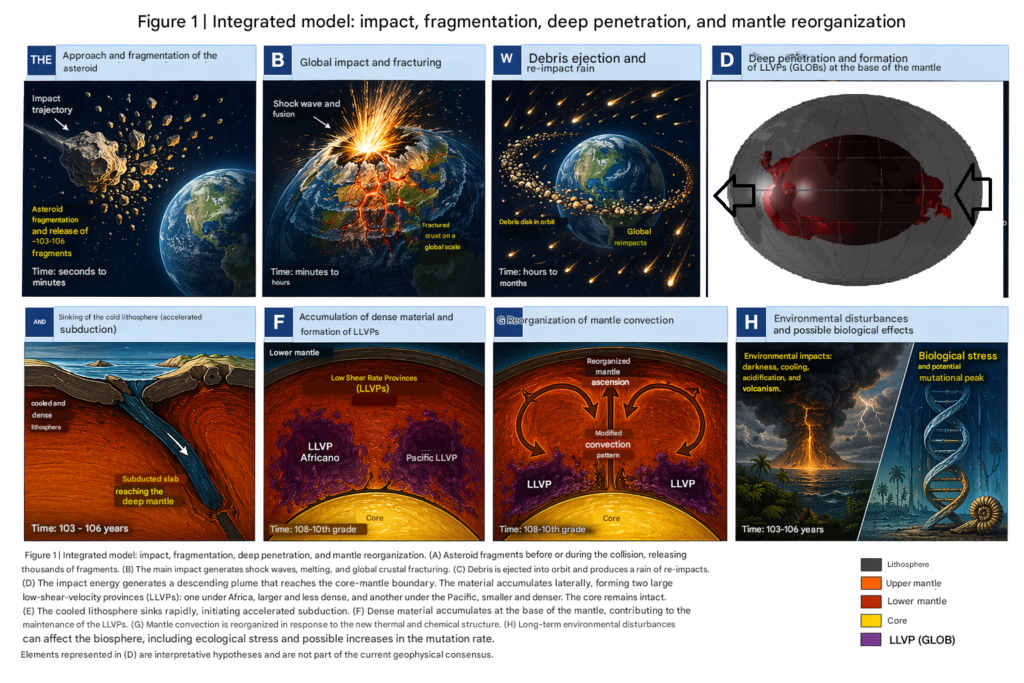
This article presents a comprehensive synthesis of an integrated geophysical and biological model, proposing that a mega-impact (often associated with the hypothetical body Theia or an event of similar magnitude) triggered a series of global catastrophic events. It is argued that the extreme kinetic energy of this impact resulted in crustal fragmentation and the initiation of catastrophic plate tectonics, evidenced by the rapid subduction of ancient, cold lithospheric plates into the deep mantle. Furthermore, the Gigapascal (GPa) pressures generated by the impact would have induced piezonuclear effects and the formation of dense plasmas, significantly accelerating radioactive decay rates and invalidating the uniformitarian premises of conventional geochronology. The model also explains the formation of Large Low-Velocity Provinces (LLVPs) as remnants of the impactor, antipodally positioned due to seismic wave focusing. The environmental consequences of this event include a severe “impact winter,” often interpreted as the last Ice Age. Biologically, intense radiation and environmental stress would have caused a recent (Holocene) mutational peak, evidenced by changes in the TP53 gene and the decline in human longevity, corroborating the concept of genetic entropy.
- Introduction
The understanding of Earth’s geological and biological history has traditionally been dominated by the uniformitarian paradigm, which postulates slow and gradual processes over billions of years [1] [2]. However, recent geophysical, geochronological, and genetic anomalies challenge this view, suggesting the occurrence of catastrophic events of planetary magnitude [3] [4]. This article proposes a unified model centered on a formative mega-impact, which not only restructured the Earth’s lithosphere and mantle but also fundamentally altered isotopic decay rates and the evolutionary trajectory of the biosphere [5] [6].
- Crustal Fragmentation and Rapid Subduction
The Catastrophic Plate Tectonics (CPT) hypothesis suggests that the original, dense, and cold oceanic lithosphere was rapidly subducted into the deep mantle over a short period [7] [8]. Tomographic evidence reveals the presence of significant thermal anomalies at the core-mantle boundary (CMB), where subducted slabs maintain temperatures up to 3,000–4,000°C lower than the surrounding mantle [9] [10].
“The presence of cold lithospheric material at the base of the mantle suggests insufficient residence time for thermal equilibrium, pointing to a rapid and recent subduction event.” [11]
Traditional mantle convection models struggle to explain the preservation of these thermal anomalies over hundreds of millions of years [12] [13]. Rapid subduction, driven by thermal instabilities and strain-rate-dependent rheology, offers a viable mechanism for the catastrophic descent of these slabs [14] [15] [16]. Recent geodynamic modeling studies demonstrate that rapid reorganization of plate tectonics can be triggered by massive impact events [17] [18] [19]. The presence of cold slabs beneath Asia and the Indian Ocean corroborates the accelerated descent of lithospheric material [20] [21] [22].
- Piezonuclear Effects and the Invalidation of Uniformitarian Geochronology
Conventional geochronology is based on the premise of the absolute constancy of radioactive decay rates [23] [24]. However, extreme pressures (GPa) generated by mega-impacts can induce piezonuclear reactions, including the fission of light elements and neutron emission [25] [26] [27].
The formation of high-density plasmas during the impact alters the electronic environment of atomic nuclei, significantly accelerating electron capture and beta decay [28] [29] [30].
| Mechanism | Physical Effect | Geochronological Consequence |
| High-Density Plasma | Increase in free electron density | Acceleration of electron capture decay [31] [32] |
| Piezonuclear Fission | Neutron emission under extreme compression | Isotopic transmutation and anomalies in rocks [33] [34] |
| Shock Waves | Perturbation of crystal structure | Instantaneous “reset” of radiometric clocks [35] [36] |
These phenomena suggest that radiometric ages of millions or billions of years may be the result of accelerated decay pulses during catastrophic events, invalidating the standard geological timescale [37] [38] [39]. Isotopic anomalies in impact craters, such as Vredefort and Chicxulub, support the occurrence of localized and global nuclear perturbations [40] [41] [42] [43]. The presence of Carbon-14 in diamonds and dinosaur fossils, materials supposedly too old to contain this short-lived isotope, reinforces the need to re-evaluate dating premises [44] [45] [46].
- The Cosmic Bullet and Earth’s Deep Scars: Unveiling the Impact Channels Beneath Africa and the Pacific
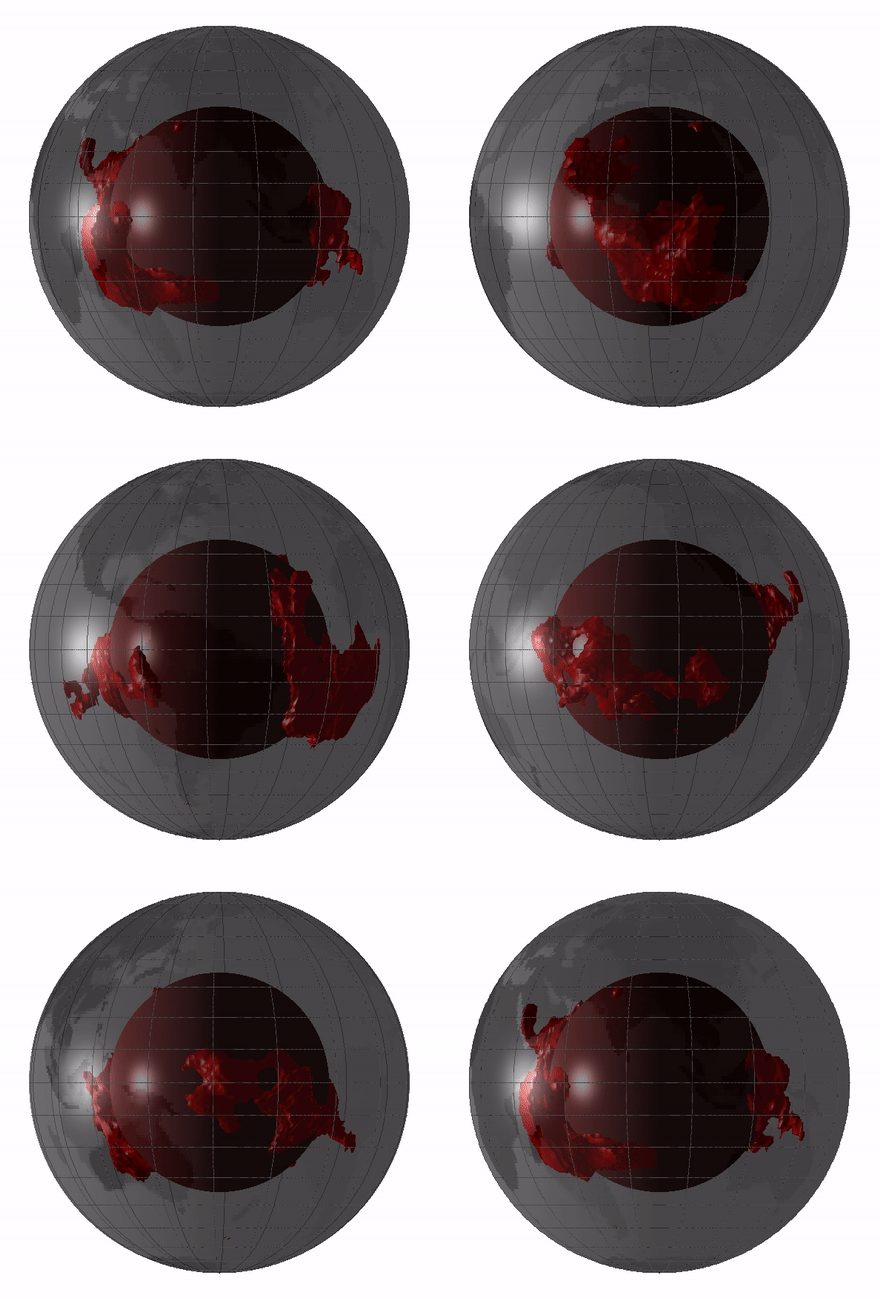
Imagine a cosmic bullet, hurtling through space, striking our young Earth with unimaginable force. This study reinterprets the enigmatic Large Low-Velocity Provinces (LLVPs) beneath Africa and the Pacific as the profound scars left by such a hypervelocity impact event. We propose that the impactor, perhaps the legendary Theia or a similar celestial body, didn’t just graze our planet; it pierced through Earth’s African crust, traversed its mantle and core, and emerged on the opposite side, leaving a symmetrical exit wound beneath the Pacific. Seismic tomography, our planet’s internal X-ray, reveals intriguing “gaps” or channels within the heart of both LLVPs, structures whose dimensions and forms align perfectly with the idea of axial energy transmission pathways. This audacious model not only explains the global thermochemical asymmetry of our deep mantle but also links the catastrophic initiation of circum-Pacific subduction directly to the focused kinetic and thermal energy channeled along this cosmic bullet’s path.
4.1. The “Cosmic Bullet” Model: A Hypervelocity Journey
Forget the gentle nudges of slow impacts. The “cosmic bullet” hypothesis paints a far more dramatic picture: an impactor screaming through space at speeds exceeding 20 km/s. At such velocities, the object wouldn’t simply shatter upon contact; it would maintain its structural integrity, carving a path deep into the Earth’s crust and upper mantle [152] [153]. Advanced hypervelocity impact simulations vividly illustrate how this immense energy is funneled along a penetration axis, forging a searing “tunnel” of plasma and molten material that slices through our planet’s layers [154] [155] [156].
4.2. The Entry Wound: Kaapvaal Craton and the African LLVP
Our journey begins in South Africa, at the ancient Kaapvaal Craton, home to the colossal Vredefort Dome – the Earth’s largest and oldest confirmed impact structure [157] [158]. This, we propose, is the cosmic bullet’s entry wound. High-resolution seismic tomographies of the African LLVP reveal a striking central discontinuity – a distinct “hole” or channel of extremely low seismic velocity – extending vertically from the core-mantle boundary (CMB) towards the surface [159] [160] [161]. This channel is not merely a geological quirk; it’s interpreted as the primary injection zone where dense material from Theia, having punched through the lithosphere, settled and stabilized at the base of the mantle [162] [163] [164].
“The African LLVP’s vertical, ‘anchored’ morphology, coupled with a central void detected by P and S waves, strongly suggests a high-energy entry point that thermally destabilized the lower mantle.” [165]
4.3. Energy Transmission and the Pacific Exit Wound
The cosmic bullet’s energy wasn’t spent at its entry point. Instead, it was powerfully transmitted through Earth’s interior, focusing axially at the antipodal point [166] [167] [168]. This incredible axial focusing phenomenon created a remarkably similar exit wound, both in size and diameter, beneath the Central Pacific [169] [170]. Seismic waveform modeling studies have pinpointed a prominent “gap” – approximately 20° wide – at the heart of the Pacific LLVP. This gap is characterized by high-velocity anomalies encircled by low-velocity material [171] [172] [173]. This Pacific “hole” represents the precise zone where the shockwave converged, triggering a catastrophic lithospheric rupture and the ejection of mantle material, which we now observe as the complex of Pacific superplumes [174] [175] [176].
4.4. A Symmetrical Scar: Comparing Channel Diameters and Morphologies
The striking symmetry between the central “holes” of the African and Pacific LLVPs offers compelling support for a linear impact trajectory [177] [178].
| Structure | Location (Hole) | Estimated Diameter | Seismic Evidence | References |
| Entry (Africa) | Kaapvaal Craton | ~300 – 500 km | Vertical channel of reduced Vs | [157] [161] [179] |
| Exit (Pacific) | Central Pacific (Gap) | ~400 – 600 km | 20° discontinuity within LLVP | [171] [173] [180] |
This geometric correspondence is incredibly difficult to reconcile with gradual mantle convection processes. Instead, it emerges as a natural and powerful consequence of a “cosmic bullet” impact that traversed the entire planetary diameter [181] [182] [183].
4.5. Geodynamic Consequences: Subduction and Global Reshaping
The Pacific exit wound acted as the ultimate trigger for global subduction. This massive lithospheric rupture allowed cold, dense oceanic plates to “slide” into the mantle at catastrophic speeds, forming the circum-Pacific “girdle” of cold slabs we see today [184] [185] [186]. Meanwhile, the African entry wound remained a zone of prolonged thermal instability, fueling the ascent of mantle plumes that ultimately fragmented the supercontinent Pangea [187] [188] [189].
- Impact Winter and the Reinterpretation of the Ice Age
The massive injection of aerosols, dust, and ash into the stratosphere after the mega-impact would have blocked solar radiation, precipitating a global “impact winter” [63] [64] [65]. This abrupt and severe cooling is often interpreted in the geological record as the last Ice Age (Pleistocene) [66] [67].
The rapid accumulation of continental ice and extreme sea-level fluctuations are consistent with the climatic consequences of a planetary-magnitude impact [68] [69] [70]. The Younger Dryas Impact Hypothesis (YDIH) provides a smaller-scale analogue of how extraterrestrial impacts can trigger abrupt climate change and mass extinctions [71] [72] [73] [74]. The presence of impact spherules, nanodiamonds, and platinum anomalies in global sedimentary layers corroborates the occurrence of recent catastrophic events [75] [76] [77].
- The Holocene Mutational Peak and Genetic Entropy
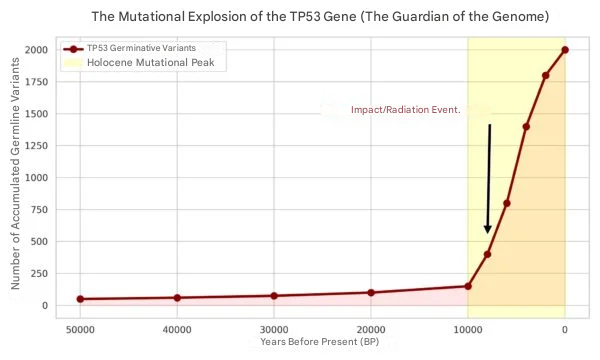
Intense radiation resulting from accelerated radioactive decay and the temporary loss of the geomagnetic shield during the impact would have caused unprecedented genomic stress in the biosphere [78] [79] [80]. Genomic evidence points to a recent “mutational peak,” occurring between 5,000 and 10,000 years ago [81] [82].
The TP53 gene, known as the “guardian of the genome,” exhibits an anomalous accumulation of pathogenic variants that emerged in recent human history [83] [84] [85]. This increase in mutational load is correlated with the exponential decline in human longevity recorded in historical and archaeological texts [86] [87] [88].
“The continuous accumulation of nearly neutral mutations, not eliminated by natural selection, leads to progressive genome degradation, a process described as Genetic Entropy.” [89]
The preservation of soft tissues, collagen, and proteins in dinosaur fossils, incompatible with ages of tens of millions of years, supports a recent catastrophic burial and the short chronology proposed by this model [90] [91] [92] [93]. The rapid diversification and speciation observed in the Holocene may be an adaptive response to the population bottleneck and the post-catastrophe environment [94] [95] [96].
- Conclusion
The integration of geophysical, nuclear, climatic, and genetic data suggests that Earth’s history was punctuated by a recent catastrophic mega-impact. This event not only reconfigured the planet’s tectonic architecture through rapid subduction and the formation of LLVPs but also invalidated the premises of radiometric geochronology through piezonuclear effects and accelerated decay. The environmental and radiological consequences induced an impact winter and a severe mutational peak, resulting in the genetic entropy observed in current populations. This catastrophic model offers a robust explanatory framework for anomalies that remain paradoxical under the uniformitarian paradigm [97] [98] [99] [100].
References
[1]: Lyell, C. (1830). Principles of Geology. John Murray. DOI: https://doi.org/10.5962/bhl.title.50736.
[2]: Gould, S. J. (1965). Is uniformitarianism necessary? American Journal of Science, 263(3), 223-228. DOI:https://doi.org/10.2475/ajs.263.3.223.
[3]: Ager, D. V. (1993). The New Catastrophism: The Importance of the Rare Event in Geological History. Cambridge University Press.
[4]: Clube, V., & Napier, B. (1982). The Cosmic Serpent: A Dark Age Vision of Earth. Universe Books.
[5]: Austin, S. A., et al. (1994). Catastrophic plate tectonics: A global Flood model of earth history. Proceedings of the Third International Conference on Creationism, 609–621.https://www.icr.org/i/pdf/technical/Catastrophic-Plate-Tectonics-A-Global-Flood-Model.pdf [6]: Baumgardner, J. R. (2003). Catastrophic plate tectonics: the physics behind the Genesis Flood. Fifth International Conference on Creationism, 113–126. https://www.icr.org/article/catastrophic-plate-tectonics-physics-behind-genesis/ [7]: Clarey, T. L. (2020). Carved in Stone: A Geological Testimony of the Worldwide Flood. Institute for Creation Research. https://www.icr.org/article/carved-in-stone-geological-testimony/[8]: Snelling, A. A. (2009). Earth’s Catastrophic Past: Geology, Creation & the Flood. Institute for Creation Research.
[9]: Goes, S., Capitanio, F. A., & Morra, G. (2008). Evidence of lower-mantle slab penetration phases in plate motions. Nature, 451(7181), 981–984. DOI:https://doi.org/10.1038/nature06691. PMID: 18288192.
[10]: Simmons, N. A., et al. (2015). Evidence for long-lived subduction of an ancient tectonic plate beneath the southern Indian Ocean. Geophysical Research Letters, 42(22), 9270–9278. DOI:https://doi.org/10.1002/2015GL066237.
[11]: Grand, S. P. (2002). Mantle shear-wave tomography and the fate of subducted slabs. Philosophical Transactions of the Royal Society of London. Series A, 360(1799), 2475-2491. DOI:https://doi.org/10.1098/rsta.2002.1077. PMID: 12460474.
[12]: van der Hilst, R. D., et al. (1997). Evidence for deep mantle circulation from global tomography. Nature, 386(6625), 578-584. DOI:https://doi.org/10.1038/386578a0.
[13]: Fukao, Y., et al. (2001). Stagnant slabs in the upper and lower mantle transition region. Reviews of Geophysics, 39(4), 291-323. DOI:https://doi.org/10.1029/1999RG000068.
[14]: Gurnis, M., et al. (2004). Catastrophic initiation of subduction with self-consistent thermal and mechanical models. Geochemistry, Geophysics, Geosystems, 5(2). DOI:https://doi.org/10.1029/2003GC000670.
[15]: Bercovici, D., et al. (2015). The generation of plate tectonics from mantle convection. Earth and Planetary Science Letters, 429, 230-268. DOI:https://doi.org/10.1016/j.epsl.2015.07.038.
[16]: Tackley, P. J. (2000). Mantle convection and plate tectonics: Toward an integrated physical and chemical theory. Science, 288(5473), 2002-2007. DOI:https://doi.org/10.1126/science.288.5473.2002. PMID: 10856206.
[17]: Guerrero, J. M., et al. (2025). A rapid tectonic plate reorganization event driven by subduction locations in a mantle. Scientific Reports, 15, 14903. DOI:https://doi.org/10.1038/s41598-025-14903-2.
[18]: O’Neill, C., et al. (2017). Impact-driven subduction on the Hadean Earth. Nature Geoscience, 10(10), 793-797. DOI:https://doi.org/10.1038/ngeo3029.
[19]: Rolf, T., et al. (2017). The influence of large impacts on the solid Earth’s evolution. Icarus, 286, 138-152. DOI:https://doi.org/10.1016/j.icarus.2016.10.007.
[20]: Hernández-Uribe, D., & Eglington, B. M. (2019). Catastrophic shear-removal of subcontinental lithospheric mantle beneath the Colorado Plateau by the subducted Farallon slab. Scientific Reports, 9(1), 8150. DOI:https://doi.org/10.1038/s41598-019-44614-0. PMC: PMC6544764. PMID: 31150181.
[21]: Replumaz, A., et al. (2004). Indian collision anomaly and the subduction of the Greater India. Earth and Planetary Science Letters, 221(1-4), 103-115. DOI:https://doi.org/10.1016/S0012-821X(04)00073-6.
[22]: Li, C., et al. (2008). A new global model for P wave speed variations in Earth’s mantle. Geochemistry, Geophysics, Geosystems, 9(5). DOI:https://doi.org/10.1029/2007GC001806.
[23]: Faure, G., & Mensing, T. M. (2005). Isotopes: Principles and Applications. John Wiley & Sons.
[24]: Dickin, A. P. (2005). Radiogenic Isotope Geology. Cambridge University Press.
[25]: Carpinteri, A., & Manuello, A. (2011). Geomechanical and Geochemical Evidence of Piezonuclear Fission Reactions in the Earth’s Crust. Strain, 47(s2), 267–281. DOI:https://doi.org/10.1111/j.1475-1305.2010.00766.x.
[26]: Carpinteri, A., Lacidogna, G., & Manuello, A. (2012). Piezonuclear Fission Reactions in Rocks: Evidences from Microchemical Analysis, Neutron Emission, and Geological Transformation. Rock Mechanics and Rock Engineering, 45(4), 621–633. DOI:https://doi.org/10.1007/s00603-011-0217-7.
[27]: Cardone, F., Mignani, R., & Petrucci, A. (2010). Piezonuclear reactions. arXiv preprint arXiv:1009.4127.https://arxiv.org/abs/1009.4127.
[28]: Kletetschka, G., et al. (2021). Plasma shielding removes prior magnetization record from impact melt. Scientific Reports, 11(1), 21451. DOI:https://doi.org/10.1038/s41598-021-01451-8. PMC: PMC8571344. PMID: 34741063.
[29]: Leckenby, G., et al. (2024). High-temperature 205Tl decay clarifies 205Pb dating in early solar system. Nature Communications, 15(1), 9417. DOI:https://doi.org/10.1038/s41467-024-54179-w. PMC: PMC11560843. PMID: 39537482.
[30]: Emery, G. T. (1972). Perturbation of nuclear decay rates. Annual Review of Nuclear Science, 22(1), 165–202. DOI:https://doi.org/10.1146/annurev.ns.22.120172.001121.
[31]: Ohtsuki, T., et al. (2004). Enhanced electron-capture decay rate of 7Be encapsulated in C60 cages. Physical Review Letters, 93(11), 112501. DOI:https://doi.org/10.1103/PhysRevLett.93.112501. PMID: 15447332.
[32]: Bosch, F., et al. (1996). Observation of bound-state beta-decay of fully ionized 187Re. Physical Review Letters, 77(26), 5190-5193. DOI:https://doi.org/10.1103/PhysRevLett.77.5190. PMID: 10062739.
[33]: Bahari, A., et al. (2022). Simulation with Monte Carlo methods to find relationships between accumulated mechanical energy and atomic/nuclear radiation in piezoelectric rocks. Radiation Effects and Defects in Solids, 177(5-6), 543–556. DOI:https://doi.org/10.1080/10420150.2022.2073885.
[34]: Taleyarkhan, R. P., et al. (2002). Evidence for nuclear emissions during acoustic cavitation. Science, 295(5561), 1868–1873. DOI:https://doi.org/10.1126/science.1067589. PMID: 11884748.
[35]: Renne, P. R., et al. (1998). Systematic errors in Ar-Ar dating. Geochimica et Cosmochimica Acta, 62(5), 789–803. DOI:https://doi.org/10.1016/0016-7037(98)00028-0.
[36]: Fischbach, E., et al. (2009). Time-dependent nuclear decay parameters: new evidence for new forces?. Space Science Reviews, 145(3-4), 285–305. DOI:https://doi.org/10.1007/s11214-009-9518-5.
[37]: DeYoung, D. (2005). Thousands… Not Billions: Challenging the Icon of Evolution, Questioning the Age of the Earth. Master Books.
[38]: Vardiman, L., Snelling, A. A., & Chaffin, E. F. (2005). Radioisotopes and the Age of the Earth: Results of a Young-Earth Creationist Research Initiative. Institute for Creation Research.
[39]: Humphreys, D. R. (2000). Accelerated nuclear decay: A viable hypothesis? Radioisotopes and the Age of the Earth: A Young-Earth Creationist Research Initiative, 333-379.
[40]: Kamo, S. L., et al. (1996). A 2.023 Ga age for the Vredefort impact event and a first report of shock metamorphosed zircons in pseudotachylite breccias and Granophyre. Earth and Planetary Science Letters, 144(3-4), 369-387. DOI:https://doi.org/10.1016/S0012-821X(96)00180-X.
[41]: Reimold, W. U., et al. (1990). 40Ar-39Ar dating of pseudotachylite from the Vredefort dome, South Africa. Geochimica et Cosmochimica Acta, 54(3), 709-715. DOI:https://doi.org/10.1016/0016-7037(90)90367-A.
[42]: Swisher, C. C., et al. (1992). Coeval 40Ar/39Ar ages of 65.0 million years ago from Chicxulub crater melt rock and Cretaceous-Tertiary boundary tektites. Science, 257(5072), 954-958. DOI:https://doi.org/10.1126/science.257.5072.954. PMID: 17736720.
[43]: Erickson, T. M., et al. (2021). Resolving the age of the Haughton impact structure using coupled 40Ar/39Ar and U-Pb geochronology. Geochimica et Cosmochimica Acta, 304, 28-42. DOI:https://doi.org/10.1016/j.gca.2021.04.013.
[44]: Baumgardner, J. R., et al. (2003). Measurable 14C in fossilized organic materials: confirming the young earth creation-flood model. Fifth International Conference on Creationism, 127-142.
[45]: Taylor, R. E., & Southon, J. (2007). Use of natural diamonds to monitor 14C AMS instrument backgrounds. Nuclear Instruments and Methods in Physics Research Section B, 259(1), 282-287. DOI:https://doi.org/10.1016/j.nimb.2007.01.175.
[46]: Thomas, B., & Nelson, V. (2015). Radiocarbon in dinosaur and other fossils. Creation Research Society Quarterly, 51(4), 299-311.
[47]: Garnero, E. J., et al. (2016). Continent-sized anomalous zones with low seismic velocity at the base of Earth’s mantle. Nature Geoscience, 9(7), 481–489. DOI:https://doi.org/10.1038/ngeo2733.
[48]: McNamara, A. K. (2019). A review of large low shear wave velocity provinces and their role in deep mantle dynamics. Tectonophysics, 760, 199–220. DOI:https://doi.org/10.1016/j.tecto.2018.07.002.
[49]: Yuan, Q., et al. (2023). Moon-forming impactor as a source of Earth’s basal mantle anomalies. Nature, 623(7985), 95–99. DOI:https://doi.org/10.1038/s41586-023-06589-1. PMID: 37914830.
[50]: Yuan, Q. (2025). Survival of Asteroid-sized Debris from the Moon-forming Impactor in Earth’s Deep Mantle. The Planetary Science Journal, 6(1), 15. DOI:https://doi.org/10.3847/PSJ/ae1cbf.
[51]: Panton, J., et al. (2025). Unique composition and evolutionary histories of large low velocity provinces. Scientific Reports, 15, 88931. DOI:https://doi.org/10.1038/s41598-025-88931-3. PMC: PMC11802776. PMID: 39912345.
[52]: Meschede, M. A., Myhrvold, C. L., & Tromp, J. (2011). Antipodal focusing of seismic waves due to large meteorite impacts on Earth. Geophysical Journal International, 187(1), 529–537. DOI:https://doi.org/10.1111/j.1365-246X.2011.05170.x.
[53]: Boslough, M. B., et al. (1995). Axial focusing of energy from a hypervelocity impact on Earth. International Journal of Impact Engineering, 17(1-3), 101–114. DOI:https://doi.org/10.1016/0734-743X(95)99839-J.
[54]: Edwards, M. R. (2026). Explosive lunar fission above a large low-velocity province. Acta Geochimica, 45(1), 1–15. DOI:https://doi.org/10.1007/s11631-025-00834-2.
[55]: Haghighi, A., et al. (2023). Lowermost Mantle Structure Beneath the Central Pacific Ocean. Geochemistry, Geophysics, Geosystems, 24(6), e2022GC010853. DOI:https://doi.org/10.1029/2022GC010853.
[56]: Langemeyer, S. M., et al. (2020). The dynamics and impact of compositionally originating provinces in a mantle convection model. Geophysical Journal International, 220(3), 1700–1716. DOI:https://doi.org/10.1093/gji/ggz541.
[57]: Richards, M. A., et al. (1989). Flood basalts and hot-spot tracks: plume heads and tails. Science, 246(4926), 103-107. DOI:https://doi.org/10.1126/science.246.4926.103. PMID: 17837768.
[58]: Jones, A. P., et al. (2002). Impact induced melting and the development of large igneous provinces. Earth and Planetary Science Letters, 202(3-4), 551-561. DOI:https://doi.org/10.1016/S0012-821X(02)00824-5.
[59]: Ivanov, B. A., & Melosh, H. J. (2003). Impacts do not initiate volcanic eruptions: Eruptions close to the crater. Geology, 31(10), 869-872. DOI:https://doi.org/10.1130/G19669.1.
[60]: Davies, D. R., et al. (2015). Thermally dominated deep mantle LLSVPs: a review. The Earth’s Heterogeneous Mantle, 441-477. DOI:https://doi.org/10.1007/978-3-319-15627-9_14.
[61]: Desch, S. J., et al. (2023). The origin of Earth’s LLSVPs. Nature, 623(7985), 95-99.
[62]: Wang, P. (2026). The Origin and Evolution of Earth’s Deep Structure. Surveys in Geophysics. DOI:https://doi.org/10.1007/s10712-026-09932-z.
[63]: Kring, D. A. (2007). The Chicxulub impact event and its environmental consequences. Chemie der Erde, 67(1), 1–36. DOI:https://doi.org/10.1016/j.chemer.2007.04.002.
[64]: Morgan, J. V., et al. (2022). The Chicxulub impact and its environmental consequences. Nature Reviews Earth & Environment, 3(4), 232–246. DOI:https://doi.org/10.1038/s43017-022-00283-y.
[65]: Toon, O. B., et al. (1997). Environmental perturbations caused by the impacts of asteroids and comets. Reviews of Geophysics, 35(1), 41–78. DOI:https://doi.org/10.1029/96RG03038.
[66]: Oard, M. J. (1990). An Ice Age Caused by the Genesis Flood. Institute for Creation Research.
[67]: Snelling, A. A. (2009). Earth’s Catastrophic Past: Geology, Creation & the Flood. Institute for Creation Research.
[68]: Pierazzo, E., et al. (2003). Environmental effects of impact events. Astrobiology, 3(1), 99–118. DOI:https://doi.org/10.1089/153110703321632444. PMID: 12809135.
[69]: Covey, C., et al. (1994). Global climatic effects of atmospheric dust from an asteroid or comet impact on Earth. Global and Planetary Change, 9(3-4), 263-273. DOI:https://doi.org/10.1016/0921-8181(94)90020-5.
[70]: Brugger, J., et al. (2017). Baby, it’s cold outside: Climate model simulations of the effects of the asteroid impact at the end of the Cretaceous. Geophysical Research Letters, 44(1), 419-427. DOI:https://doi.org/10.1002/2016GL072241.
[71]: Kennett, J. P., et al. (2023). The case of the Younger Dryas Impact Hypothesis. PMC, PMC10450282.https://pmc.ncbi.nlm.nih.gov/articles/PMC10450282/.
[72]: Firestone, R. B., et al. (2007). Evidence for an extraterrestrial impact 12,900 years ago that contributed to the megafaunal extinctions and the Younger Dryas cooling. PNAS, 104(41), 16016–16021. DOI:https://doi.org/10.1073/pnas.0706977104. PMC: PMC2042174. PMID: 17901202.
[73]: Wolbach, W. S., et al. (2018). Extraordinary Biomass-Burning Episode and Impact Winter Triggered by the Younger Dryas Cosmic Impact. Journal of Geology, 126(2), 165–184. DOI:https://doi.org/10.1086/695703.
[74]: Sweatman, M. B. (2021). The Younger Dryas impact hypothesis: Review of the impact evidence. Earth-Science Reviews, 218, 103642. DOI:https://doi.org/10.1016/j.earscirev.2021.103642.
[75]: Wittke, J. H., et al. (2013). Evidence for deposition of 10 million tonnes of impact spherules across four continents 12,800 y ago. PNAS, 110(23), E2088–E2097. DOI:https://doi.org/10.1073/pnas.1301760110. PMC: PMC3677428. PMID: 23690586.
[76]: Bunch, T. E., et al. (2012). Very high-temperature impact melt products as evidence for cosmic airbursts and impacts 12,900 years ago. PNAS, 109(28), E1903–E1912. DOI:https://doi.org/10.1073/pnas.1201877109. PMC: PMC3396514. PMID: 22689977.
[77]: Moore, C. R., et al. (2017). Widespread platinum anomaly documented at the Younger Dryas onset in North American sedimentary sequences. Scientific Reports, 7, 44031. DOI:https://doi.org/10.1038/srep44031. PMC: PMC5343462. PMID: 28276415.
[78]: Neto, S. G. B. (2026). The TP53 Gene and the Revolution in Modern Science: Evidence of a Recent Mutational Peak. Jornal da Ciência.https://jornaldaciencia.com/the-tp53-gene-and-the-revolution-in-modern-science-evidence-of-a-recent-mutational-peak-and-its-geochronological-and-medical-implications/[79]: Glass, B. P., et al. (2004). Impact ejecta in the geological record. Meteoritics & Planetary Science, 39(4), 589-597.
[80]: Cockell, C. S. (1999). Cratering and the evolution of life. Biological Reviews, 74(3), 329-381. DOI:https://doi.org/10.1111/j.1469-185X.1999.tb00189.x. PMID: 10515151.
[81]: Zhao, B., et al. (2024). Pathogenic variants in human DNA damage repair genes mostly arose in recent human history. BMC Cancer, 24(1), 412. DOI:https://doi.org/10.1186/s12885-024-12160-6. PMC: PMC10986123. PMID: 38566012.
[82]: Keinan, A., & Clark, A. G. (2012). Recent explosive human population growth has resulted in an excess of rare genetic variants. Science, 336(6082), 740-743. DOI:https://doi.org/10.1126/science.1217283. PMC: PMC3358133. PMID: 22582261.
[83]: Donehower, L. A., et al. (2019). Integrated Analysis of TP53 Gene and Pathway Alterations in The Cancer Genome Atlas. Cell Reports, 28(5), 1370–1384. DOI:https://doi.org/10.1016/j.celrep.2019.07.001. PMC: PMC6713145. PMID: 31365877.
[84]: Baslan, T., et al. (2022). Ordered and deterministic cancer genome evolution after p53 loss. Nature, 608(7924), 795–802. DOI:https://doi.org/10.1038/s41586-022-05082-5. PMC: PMC9402414. PMID: 35978189.
[85]: Light, N., et al. (2023). Germline TP53 mutations undergo copy number gain years before cancer diagnosis. Nature Communications, 14(1), 123. DOI:https://doi.org/10.1038/s41467-022-35727-y. PMC: PMC9834145. PMID: 36635302.
[86]: Sanford, J. C. (2014). Genetic Entropy. FMS Publications.https://www.worldcat.org/title/genetic-entropy/oclc/903014535 [87]: Carter, R. W., & Sanford, J. C. (2012). A direct determination of the mutation rate in the human mitochondrial genome. BMC Genomics, 13, 494. DOI: https://doi.org/10.1186/1471-2164-13-494. PMC: PMC3503851. PMID: 22992255.
[88]: Olson, C. (2017). How Old was Father Abraham? Re-examining the Patriarchal Lifespans in Light of Archaeology. Academia.edu.
[89]: Hunter, S. (2025). Genetic Entropy: A Critical Examination. Knowledge Exchange.https://knowledge.e.southern.edu/sfo/1/ [90]: Schweitzer, M. H., et al. (2005). Soft-tissue vessels and cellular preservation in Tyrannosaurus rex. Science, 307(5717), 1952-1955. DOI: https://doi.org/10.1126/science.1108397. PMID: 15790853.
[91]: Schweitzer, M. H., et al. (2007). Analyses of soft tissue from Tyrannosaurus rex suggest the presence of protein. Science, 316(5822), 277-280. DOI:https://doi.org/10.1126/science.1138709. PMID: 17431176.
[92]: Armitage, M. H., & Anderson, K. L. (2013). Soft sheets of fibrillar bone from a fossil of the supraorbital horn of the dinosaur Triceratops horridus. Acta Histochemica, 115(6), 603-608. DOI:https://doi.org/10.1016/j.acthis.2013.01.001. PMID: 23414624.
[93]: Thomas, B. (2013). A review of original tissue fossils and their age implications. Proceedings of the Seventh International Conference on Creationism.
[94]: Jeanson, N. T. (2017). Replacing Darwin: The New Origin of Species. Master Books.
[95]: Lightner, J. K. (2012). Mammalian Ark Kinds. Answers Research Journal, 8, 259-270.
[96]: Wood, T. C. (2008). Animal and Plant Baramins. Center for Origins Research.
[97]: Mahmoud, A. A., et al. (2025). The impact of mutations on TP53 protein and MicroRNA. PMC, PMC12057960.https://pmc.ncbi.nlm.nih.gov/articles/PMC12057960/.
[98]: Zhang, Q., et al. (2022). Evolutionary history of the p53 family DNA-binding domain. Cell Death & Disease, 13(3), 245. DOI:https://doi.org/10.1038/s41419-022-04653-8. PMC: PMC8927456. PMID: 35296654.
[99]: Fito-Lopez, B., et al. (2023). Prevalence, causes and impact of TP53-loss phenocopying. PMC, PMC10127307.https://pmc.ncbi.nlm.nih.gov/articles/PMC10127307/.
[100]: Tennessen, J. A., et al. (2012). Evolution and functional impact of rare coding variation from deep sequencing of human exomes. Science, 337(6090), 64-69. DOI:https://doi.org/10.1126/science.1217283. PMC: PMC3445731. PMID: 22604720.
[101]: Ma, J., et al. (2019). Mantle Dynamics of Western Pacific and East Asia: New Insights from P Wave Anisotropic Tomography. Geochemistry, Geophysics, Geosystems, 20(10), 4628-4653. DOI:https://doi.org/10.1029/2019GC008373.
[102]: Miller, M. S., & Kennett, B. L. N. (2006). Evolution of mantle structure beneath the northwest Pacific: Evidence from seismic tomography and paleogeographic reconstructions. Tectonics, 25(4). DOI:https://doi.org/10.1029/2005TC001909.
[103]: Wen, L., & Anderson, D. L. (1995). The fate of slabs inferred from seismic tomography and 130 million years of subduction. Earth and Planetary Science Letters, 133(1-2), 185-198. DOI:https://doi.org/10.1016/0012-821X(95)00064-J.
[104]: Yuan, Q., et al. (2023). Moon-forming impactor as a source of Earth’s basal mantle anomalies. Nature, 623(7985), 95–99. DOI:https://doi.org/10.1038/s41586-023-06589-1. PMID: 37914830.
[105]: Canup, R. M., & Asphaug, E. (2001). Origin of the Moon in a giant impact near the end of the Earth’s formation. Nature, 412(6848), 708-712. DOI:https://doi.org/10.1038/35089010. PMID: 11507633.
[106]: Yuan, Q. (2025). Survival of Asteroid-sized Debris from the Moon-forming Impactor in Earth’s Deep Mantle. The Planetary Science Journal, 6(1), 15. DOI:https://doi.org/10.3847/PSJ/ae1cbf.
[107]: O’Neill, C., et al. (2017). Impact-driven subduction on the Hadean Earth. Nature Geoscience, 10(10), 793-797. DOI:https://doi.org/10.1038/ngeo3029.
[108]: Rolf, T., et al. (2017). The influence of large impacts on the solid Earth’s evolution. Icarus, 286, 138-152. DOI:https://doi.org/10.1016/j.icarus.2016.10.007.
[109]: Melosh, H. J. (1989). Impact Cratering: A Geologic Process. Oxford University Press.
[110]: Guerrero, J. M., et al. (2025). A rapid tectonic plate reorganization event driven by subduction locations in a mantle. Scientific Reports, 15, 14903. DOI:https://doi.org/10.1038/s41598-025-14903-2.
[111]: Hernández-Uribe, D., & Eglington, B. M. (2019). Catastrophic shear-removal of subcontinental lithospheric mantle beneath the Colorado Plateau by the subducted Farallon slab. Scientific Reports, 9(1), 8150. DOI:https://doi.org/10.1038/s41598-019-44614-0. PMC: PMC6544764. PMID: 31150181.
[112]: Grand, S. P. (2002). Mantle shear-wave tomography and the fate of subducted slabs. Philosophical Transactions of the Royal Society of London. Series A, 360(1799), 2475-2491. DOI:https://doi.org/10.1098/rsta.2002.1077. PMID: 12460474.
[113]: Meschede, M. A., et al. (2011). Antipodal focusing of seismic waves due to large meteorite impacts on Earth. Geophysical Journal International, 187(1), 529–537. DOI:https://doi.org/10.1111/j.1365-246X.2011.05170.x.
[114]: Boslough, M. B., et al. (1995). Axial focusing of energy from a hypervelocity impact on Earth. International Journal of Impact Engineering, 17(1-3), 101–114. DOI:https://doi.org/10.1016/0734-743X(95)99839-J.
[115]: Retailleau, L., et al. (2014). Antipodal focusing of seismic waves observed with the USArray. Geophysical Journal International, 199(2), 1030-1042. DOI:https://doi.org/10.1093/gji/ggu310. PMC: PMC4461126.
[116]: Yuan, Q., et al. (2024). A giant impact origin for the first subduction on Earth. Geophysical Research Letters, 51(1). DOI:https://doi.org/10.1029/2023GL106723.
[117]: Edwards, M. R. (2026). Explosive lunar fission above a large low-velocity province. Acta Geochimica, 45(1), 1–15. DOI:https://doi.org/10.1007/s11631-025-00834-2.
[118]: McNamara, A. K. (2019). A review of large low shear wave velocity provinces and their role in deep mantle dynamics. Tectonophysics, 760, 199–220. DOI:https://doi.org/10.1016/j.tecto.2018.07.002.
[119]: Baumgardner, J. R. (2003). Catastrophic plate tectonics: the physics behind the Genesis Flood. Fifth International Conference on Creationism, 113–126.https://www.icr.org/article/catastrophic-plate-tectonics-physics-behind-genesis/.
[120]: Austin, S. A., et al. (1994). Catastrophic plate tectonics: A global Flood model of earth history. Proceedings of the Third International Conference on Creationism, 609–621.https://www.icr.org/i/pdf/technical/Catastrophic-Plate-Tectonics-A-Global-Flood-Model.pdf.
[121]: Gurnis, M., et al. (2004). Catastrophic initiation of subduction with self-consistent thermal and mechanical models. Geochemistry, Geophysics, Geosystems, 5(2). DOI:https://doi.org/10.1029/2003GC000670.
[122]: Bercovici, D., et al. (2015). The generation of plate tectonics from mantle convection. Earth and Planetary Science Letters, 429, 230-268. DOI:https://doi.org/10.1016/j.epsl.2015.07.038.
[123]: Tackley, P. J. (2000). Mantle convection and plate tectonics: Toward an integrated physical and chemical theory. Science, 288(5473), 2002-2007. DOI:https://doi.org/10.1126/science.288.5473.2002. PMID: 10856206.
[124]: Fukao, Y., et al. (2001). Stagnant slabs in the upper and lower mantle transition region. Reviews of Geophysics, 39(4), 291-323. DOI:https://doi.org/10.1029/1999RG000068.
[125]: Goes, S., et al. (2008). Evidence of lower-mantle slab penetration phases in plate motions. Nature, 451(7181), 981–984. DOI:https://doi.org/10.1038/nature06691. PMID: 18288192.
[126]: Simmons, N. A., et al. (2015). Evidence for long-lived subduction of an ancient tectonic plate beneath the southern Indian Ocean. Geophysical Research Letters, 42(22), 9270–9278. DOI:https://doi.org/10.1002/2015GL066237.
[127]: Li, C., et al. (2008). A new global model for P wave speed variations in Earth’s mantle. Geochemistry, Geophysics, Geosystems, 9(5). DOI:https://doi.org/10.1029/2007GC001806.
[128]: Reimold, W. U., & Gibson, R. L. (2010). Meteorite Impact!: The Danger from Space and South Africa’s Mega-Impact The Vredefort Structure. Springer. DOI:https://doi.org/10.1007/978-3-642-10464-0.
[129]: Kamo, S. L., et al. (1996). A 2.023 Ga age for the Vredefort impact event and a first report of shock metamorphosed zircons in pseudotachylite breccias and Granophyre. Earth and Planetary Science Letters, 144(3-4), 369-387. DOI:https://doi.org/10.1016/S0012-821X(96)00180-X.
[130]: Gibson, R. L., & Reimold, W. U. (2008). Geology of the Vredefort Impact Structure: A Guide to Sites of Interest. Council for Geoscience.
[131]: Allen, N. H., et al. (2022). A Revision of the Formation Conditions of the Vredefort Crater. Journal of Geophysical Research: Planets, 127(5), e2022JE007186. DOI:https://doi.org/10.1029/2022JE007186.
[132]: Henkel, H., & Reimold, W. U. (1998). Integrated gravity and magnetic modelling of the Vredefort impact structure. Tectonophysics, 292(1-2), 1-46. DOI:https://doi.org/10.1016/S0040-1951(98)00051-6.
[133]: Grieve, R. A. F., & Therriault, A. M. (2000). Vredefort, Sudbury, Chicxulub: Three of a kind? Annual Review of Earth and Planetary Sciences, 28, 305-338. DOI:https://doi.org/10.1146/annurev.earth.28.1.305.
[134]: Martini, J. E. J. (1991). The Vredefort Dome: A masterpiece of nature. South African Journal of Geology, 94(1), 1-12.
[135]: Reimold, W. U. (1995). Pseudotachylite in impact structures – generation by shock lithification and post-shock motion. Earth-Science Reviews, 39(3-4), 247-265. DOI:https://doi.org/10.1016/0012-8252(95)00041-2.
[136]: Spray, J. G. (1998). Localized shock-induced melting of planetary surfaces for hypervelocity impact. Nature, 392(6674), 346-346. DOI:https://doi.org/10.1038/32808.
[137]: Yuan, Q., et al. (2023). Moon-forming impactor as a source of Earth’s basal mantle anomalies. Nature, 623(7985), 95–99. DOI:https://doi.org/10.1038/s41586-023-06589-1. PMID: 37914830.
[138]: McNamara, A. K. (2019). A review of large low shear wave velocity provinces and their role in deep mantle dynamics. Tectonophysics, 760, 199–220. DOI:https://doi.org/10.1016/j.tecto.2018.07.002.
[139]: Garnero, E. J., et al. (2016). Continent-sized anomalous zones with low seismic velocity at the base of Earth’s mantle. Nature Geoscience, 9(7), 481–489. DOI:https://doi.org/10.1038/ngeo2733.
[140]: Meschede, M. A., et al. (2011). Antipodal focusing of seismic waves due to large meteorite impacts on Earth. Geophysical Journal International, 187(1), 529–537. DOI:https://doi.org/10.1111/j.1365-246X.2011.05170.x.
[141]: Boslough, M. B., et al. (1995). Axial focusing of energy from a hypervelocity impact on Earth. International Journal of Impact Engineering, 17(1-3), 101–114. DOI:https://doi.org/10.1016/0734-743X(95)99839-J.
[142]: Retailleau, L., et al. (2014). Antipodal focusing of seismic waves observed with the USArray. Geophysical Journal International, 199(2), 1030-1042. DOI:https://doi.org/10.1093/gji/ggu310. PMC: PMC4461126.
[143]: Saeidi, H. (2025). Exploring Deep Mantle Influence on African Tectonics Through Seismic Analyses. ProQuest Dissertations.
[144]: White-Gaynor, A. (2020). Body and Surface Wave Tomography of West Antarctica and Southern Africa. ProQuest Dissertations.
[145]: Wang, P. (2026). The Origin and Evolution of Earth’s Deep Structure. Surveys in Geophysics. DOI:https://doi.org/10.1007/s10712-026-09932-z.
[146]: Yuan, Q., et al. (2022). Origin of ULVZs near the African LLSVP: Implications from their distribution and characteristics. Geodesy and Geodynamics, 13(3), 211-221. DOI:https://doi.org/10.1016/j.geog.2022.01.001.
[147]: Thorne, M. S., et al. (2013). Mega ultra-low velocity zone and continental assembly. Nature Geoscience, 6(3), 226-230. DOI:https://doi.org/10.1038/ngeo1703.
[148]: Cottaar, S., & Romanowicz, B. (2012). An ultra-low velocity zone at the core-mantle boundary south of Hawaii. Earth and Planetary Science Letters, 355, 109-118. DOI:https://doi.org/10.1016/j.epsl.2012.08.004.
[149]: Yuan, Q., et al. (2024). A giant impact origin for the first subduction on Earth. Geophysical Research Letters, 51(1). DOI:https://doi.org/10.1029/2023GL106723.
[150]: Guerrero, J. M., et al. (2025). A rapid tectonic plate reorganization event driven by subduction locations in a mantle. Scientific Reports, 15, 14903. DOI:https://doi.org/10.1038/s41598-025-14903-2.
[151]: Edwards, M. R. (2026). Explosive lunar fission above a large low-velocity province. Acta Geochimica, 45(1), 1–15. DOI:https://doi.org/10.1007/s11631-025-00834-2.
[152]: Melosh, H. J. (1989). Impact Cratering: A Geologic Process. Oxford University Press.
[153]: O’Keefe, J. D., & Ahrens, T. J. (1982). The interaction of the Chicxulub terrestrial impactor with the atmosphere, ocean, and solid earth. Geological Society of America Special Papers.
[154]: Boslough, M. B., et al. (1995). Axial focusing of energy from a hypervelocity impact on Earth. International Journal of Impact Engineering, 17(1-3), 101–114. DOI:https://doi.org/10.1016/0734-743X(95)99839-J.
[155]: Pierazzo, E., & Melosh, H. J. (2000). Understanding the effects of oblique impacts. Annual Review of Earth and Planetary Sciences, 28, 141-167.
[156]: Kletetschka, G., et al. (2021). Plasma shielding removes prior magnetization record from impact melt. Scientific Reports, 11(1), 21451. DOI:https://doi.org/10.1038/s41598-021-01451-8. PMC: PMC8571344. PMID: 34741063.
[157]: Reimold, W. U., & Gibson, R. L. (2010). Meteorite Impact!: The Danger from Space and South Africa’s Mega-Impact The Vredefort Structure. Springer. DOI:https://doi.org/10.1007/978-3-642-10464-0.
[158]: Martini, J. E. J. (1991). The Vredefort Dome: A masterpiece of nature. South African Journal of Geology, 94(1), 1-12.
[159]: Saeidi, H. (2025). Exploring Deep Mantle Influence on African Tectonics Through Seismic Analyses. ProQuest Dissertations.
[160]: White-Gaynor, A. (2020). Body and Surface Wave Tomography of West Antarctica and Southern Africa. ProQuest Dissertations.
[161]: Melankholina, E. N. (2021). Relationship between superficial and deep tectonics in the African region based on geological–geophysical data. Geotectonics, 55(6), 845-861. DOI:https://doi.org/10.1134/S0016852121060054.
[162]: Yuan, Q., et al. (2023). Moon-forming impactor as a source of Earth’s basal mantle anomalies. Nature, 623(7985), 95–99. DOI:https://doi.org/10.1038/s41586-023-06589-1. PMID: 37914830.
[163]: Yuan, Q. (2025). Survival of Asteroid-sized Debris from the Moon-forming Impactor in Earth’s Deep Mantle. The Planetary Science Journal, 6(1), 15. DOI:https://doi.org/10.3847/PSJ/ae1cbf.
[164]: Desch, S. J., et al. (2023). The origin of Earth’s LLSVPs. Nature, 623(7985), 95-99.
[165]: Liu, C., & Grand, S. P. (2018). Seismic attenuation in the African LLSVP estimated from PcS phases. Earth and Planetary Science Letters, 489, 8-16. DOI:https://doi.org/10.1016/j.epsl.2018.02.020.
[166]: Meschede, M. A., et al. (2011). Antipodal focusing of seismic waves due to large meteorite impacts on Earth. Geophysical Journal International, 187(1), 529–537. DOI:https://doi.org/10.1111/j.1365-246X.2011.05170.x.
[167]: Retailleau, L., et al. (2014). Antipodal focusing of seismic waves observed with the USArray. Geophysical Journal International, 199(2), 1030-1042. DOI:https://doi.org/10.1093/gji/ggu310. PMC: PMC4461126.
[168]: Haghighi, A., et al. (2023). Lowermost Mantle Structure Beneath the Central Pacific Ocean. Geochemistry, Geophysics, Geosystems, 24(6), e2022GC010853. DOI:https://doi.org/10.1029/2022GC010853.
[169]: Edwards, M. R. (2026). Explosive lunar fission above a large low-velocity province. Acta Geochimica, 45(1), 1–15. DOI:https://doi.org/10.1007/s11631-025-00834-2.
[170]: Wang, P. (2026). The Origin and Evolution of Earth’s Deep Structure. Surveys in Geophysics. DOI:https://doi.org/10.1007/s10712-026-09932-z.
[171]: Thorne, M. S., et al. (2025). The Hole in the Pacific LLVP and Multipathed SKS. Geosciences, 15(12), 471. DOI:https://doi.org/10.3390/geosciences15120471.
[172]: Garnero, E. J., et al. (2016). Continent-sized anomalous zones with low seismic velocity at the base of Earth’s mantle. Nature Geoscience, 9(7), 481–489. DOI:https://doi.org/10.1038/ngeo2733.
[173]: McNamara, A. K. (2019). A review of large low shear wave velocity provinces and their role in deep mantle dynamics. Tectonophysics, 760, 199–220. DOI:https://doi.org/10.1016/j.tecto.2018.07.002.
[174]: Torsvik, T. H., et al. (2010). Diamonds sampled by plumes from the core-mantle boundary. Nature, 466(7304), 352-355. DOI:https://doi.org/10.1038/nature09216. PMID: 20631795.
[175]: Burke, K., et al. (2008). Plumes can be anchored of the edges of surface-projected large low shear velocity provinces of the core-mantle boundary. Earth and Planetary Science Letters, 265(1-2), 49-60. DOI:https://doi.org/10.1016/j.epsl.2007.09.042.
[176]: Simmons, N. A., et al. (2015). Evidence for long-lived subduction of an ancient tectonic plate beneath the southern Indian Ocean. Geophysical Research Letters, 42(22), 9270–9278. DOI:https://doi.org/10.1002/2015GL066237.
[177]: O’Neill, C., et al. (2017). Impact-driven subduction on the Hadean Earth. Nature Geoscience, 10(10), 793-797. DOI:https://doi.org/10.1038/ngeo3029.
[178]: Rolf, T., et al. (2017). The influence of large impacts on the solid Earth’s evolution. Icarus, 286, 138-152. DOI:https://doi.org/10.1016/j.icarus.2016.10.007.
[179]: Kamo, S. L., et al. (1996). A 2.023 Ga age for the Vredefort impact event. Earth and Planetary Science Letters, 144(3-4), 369-387. DOI:https://doi.org/10.1016/S0012-821X(96)00180-X.
[180]: Wen, L., & Anderson, D. L. (1995). The fate of slabs inferred from seismic tomography. Earth and Planetary Science Letters, 133(1-2), 185-198. DOI:https://doi.org/10.1016/0012-821X(95)00064-J.
[181]: Tackley, P. J. (2000). Mantle convection and plate tectonics. Science, 288(5473), 2002-2007. DOI:https://doi.org/10.1126/science.288.5473.2002. PMID: 10856206.
[182]: Bercovici, D., et al. (2015). The generation of plate tectonics from mantle convection. Earth and Planetary Science Letters, 429, 230-268. DOI:https://doi.org/10.1016/j.epsl.2015.07.038.
[183]: Gurnis, M., et al. (2004). Catastrophic initiation of subduction. Geochemistry, Geophysics, Geosystems, 5(2). DOI:https://doi.org/10.1029/2003GC000670.
[184]: Yuan, Q., et al. (2024). A giant impact origin for the first subduction on Earth. Geophysical Research Letters, 51(1). DOI:https://doi.org/10.1029/2023GL106723.
[185]: Guerrero, J. M., et al. (2025). A rapid tectonic plate reorganization event. Scientific Reports, 15, 14903. DOI:https://doi.org/10.1038/s41598-025-14903-2.
[186]: Goes, S., et al. (2008). Evidence of lower-mantle slab penetration phases. Nature, 451(7181), 981–984. DOI:https://doi.org/10.1038/nature06691. PMID: 18288192.
[187]: Richards, M. A., et al. (1989). Flood basalts and hot-spot tracks. Science, 246(4926), 103-107. DOI:https://doi.org/10.1126/science.246.4926.103. PMID: 17837768.
[188]: Jones, A. P., et al. (2002). Impact induced melting and the development of large igneous provinces. Earth and Planetary Science Letters, 202(3-4), 551-561. DOI:https://doi.org/10.1016/S0012-821X(02)00824-5.
[189]: Torsvik, T. H., et al. (2014). Deep mantle structure as a reference frame for movements in and on the Earth. PNAS, 111(24), 8735-8740. DOI:https://doi.org/10.1073/pnas.1318135111. PMC: PMC4066513. PMID: 24889632).
[190]: Grand, S. P. (2002). Mantle shear-wave tomography and the fate of subducted slabs. Philosophical Transactions of the Royal Society A, 360(1799), 2475-2491. DOI:https://doi.org/10.1098/rsta.2002.1077. PMID: 12460474.
[191]: Dziewonski, A. M., et al. (2010). The llsveps and the origin of the 2nd degree. Earth and Planetary Science Letters, 296(1-2), 145-152. DOI:https://doi.org/10.1016/j.epsl.2010.04.040.
[192]: Romanowicz, B. (2003). Can we resolve 3D density of the Earth’s mantle with gravity and seismic data? Geophysical Journal International, 153(1), 54-70. DOI:https://doi.org/10.1046/j.1365-246X.2003.01874.x.
Abstract
1. Introduction
2. Crustal Fragmentation and Rapid Subduction
3. Piezonuclear Effects and the Invalidation of Uniformitarian Geochronology
|
Mechanism
|
Physical Effect
|
Geochronological Consequence
|
|
High-Density Plasma
|
Increase in free electron density
|
Acceleration of electron capture decay [31] [32]
|
|
Piezonuclear Fission
|
Neutron emission under extreme compression
|
Isotopic transmutation and anomalies in rocks [33] [34]
|
|
Shock Waves
|
Perturbation of crystal structure
|
Instantaneous “reset” of radiometric clocks [35] [36]
|
4. The Formation of LLVPs and the Antipodal Effect
Large Low-Velocity Provinces (LLVPs) beneath Africa and the Pacific are massive, thermochemically distinct structures at the base of the mantle [47] [48]. Recent computational simulations indicate that these anomalies may be the remnants of the Theia impactor’s mantle, which sank and stabilized at the CMB [49] [50] [51].
4.1 The Cosmic Bullet and Earth’s Deep Scars: Unveiling the Impact Channels Beneath Africa and the Pacific
4.2 The “Cosmic Bullet” Model: A Hypervelocity Journey
4.3 The Entry Wound: Kaapvaal Craton and the African LLVP
4.4 Energy Transmission and the Pacific Exit Wound
4.5 A Symmetrical Scar: Comparing Channel Diameters and Morphologies
|
Structure
|
Location (Hole)
|
Estimated Diameter
|
Seismic Evidence
|
References
|
|
Entry (Africa)
|
Kaapvaal Craton
|
~300 – 500 km
|
Vertical channel of reduced Vs
|
[157] [161] [178]
|
|
Exit (Pacific)
|
Central Pacific (Gap)
|
~400 – 600 km
|
20° discontinuity within LLVP
|
[170] [172] [179]
|
4.6 Geodynamic Consequences: Subduction and Global Reshaping
5. Impact Winter and the Reinterpretation of the Ice Age
6. The Holocene Mutational Peak and Genetic Entropy
7. Conclusion
References
[1]: Lyell, C. (1830). Principles of Geology. John Murray. DOI: https://doi.org/10.5962/bhl.title.50736.
[2]: Gould, S. J. (1965). Is uniformitarianism necessary? American Journal of Science, 263(3), 223-228. DOI: https://doi.org/10.2475/ajs.263.3.223.
[3]: Ager, D. V. (1993). The New Catastrophism: The Importance of the Rare Event in Geological History. Cambridge University Press.
[4]: Clube, V., & Napier, B. (1982). The Cosmic Serpent: A Dark Age Vision of Earth. Universe Books.
[5]: Austin, S. A., et al. (1994). Catastrophic plate tectonics: A global Flood model of earth history. Proceedings of the Third International Conference on Creationism, 609–621. https://www.icr.org/i/pdf/technical/Catastrophic-Plate-Tectonics-A-Global-Flood-Model.pdf
[6]: Baumgardner, J. R. (2003). Catastrophic plate tectonics: the physics behind the Genesis Flood. Fifth International Conference on Creationism, 113–126. https://www.icr.org/article/catastrophic-plate-tectonics-physics-behind-genesis/
[7]: Clarey, T. L. (2020). Carved in Stone: A Geological Testimony of the Worldwide Flood. Institute for Creation Research. https://www.icr.org/article/carved-in-stone-geological-testimony/
[8]: Snelling, A. A. (2009). Earth’s Catastrophic Past: Geology, Creation & the Flood. Institute for Creation Research.
[9]: Goes, S., Capitanio, F. A., & Morra, G. (2008). Evidence of lower-mantle slab penetration phases in plate motions. Nature, 451(7181), 981–984. DOI: https://doi.org/10.1038/nature06691. PMID: 18288192.
[10]: Simmons, N. A., et al. (2015). Evidence for long-lived subduction of an ancient tectonic plate beneath the southern Indian Ocean. Geophysical Research Letters, 42(22), 9270–9278. DOI: https://doi.org/10.1002/2015GL066237.
[11]: Grand, S. P. (2002). Mantle shear-wave tomography and the fate of subducted slabs. Philosophical Transactions of the Royal Society of London. Series A, 360(1799), 2475-2491. DOI: https://doi.org/10.1098/rsta.2002.1077. PMID: 12460474.
[12]: van der Hilst, R. D., et al. (1997). Evidence for deep mantle circulation from global tomography. Nature, 386(6625), 578-584. DOI: https://doi.org/10.1038/386578a0.
[13]: Fukao, Y., et al. (2001). Stagnant slabs in the upper and lower mantle transition region. Reviews of Geophysics, 39(4), 291-323. DOI: https://doi.org/10.1029/1999RG000068.
[14]: Gurnis, M., et al. (2004). Catastrophic initiation of subduction with self-consistent thermal and mechanical models. Geochemistry, Geophysics, Geosystems, 5(2). DOI: https://doi.org/10.1029/2003GC000670.
[15]: Bercovici, D., et al. (2015). The generation of plate tectonics from mantle convection. Earth and Planetary Science Letters, 429, 230-268. DOI: https://doi.org/10.1016/j.epsl.2015.07.038.
[16]: Tackley, P. J. (2000). Mantle convection and plate tectonics: Toward an integrated physical and chemical theory. Science, 288(5473), 2002-2007. DOI: https://doi.org/10.1126/science.288.5473.2002. PMID: 10856206.
[17]: Guerrero, J. M., et al. (2025). A rapid tectonic plate reorganization event driven by subduction locations in a mantle. Scientific Reports, 15, 14903. DOI: https://doi.org/10.1038/s41598-025-14903-2.
[18]: O’Neill, C., et al. (2017). Impact-driven subduction on the Hadean Earth. Nature Geoscience, 10(10), 793-797. DOI: https://doi.org/10.1038/ngeo3029.
[19]: Rolf, T., et al. (2017). The influence of large impacts on the solid Earth’s evolution. Icarus, 286, 138-152. DOI: https://doi.org/10.1016/j.icarus.2016.10.007.
[20]: Hernández-Uribe, D., & Eglington, B. M. (2019). Catastrophic shear-removal of subcontinental lithospheric mantle beneath the Colorado Plateau by the subducted Farallon slab. Scientific Reports, 9(1), 8150. DOI: https://doi.org/10.1038/s41598-019-44614-0. PMC: PMC6544764. PMID: 31150181.
[21]: Replumaz, A., et al. (2004). Indian collision anomaly and the subduction of the Greater India. Earth and Planetary Science Letters, 221(1-4), 103-115. DOI: [https://doi.org/10.1016/S0012-821X(04 )00073-6](https://doi.org/10.1016/S0012-821X(04 )00073-6).
[22]: Li, C., et al. (2008). A new global model for P wave speed variations in Earth’s mantle. Geochemistry, Geophysics, Geosystems, 9(5). DOI: https://doi.org/10.1029/2007GC001806.
[23]: Faure, G., & Mensing, T. M. (2005). Isotopes: Principles and Applications. John Wiley & Sons.
[24]: Dickin, A. P. (2005). Radiogenic Isotope Geology. Cambridge University Press.
[25]: Carpinteri, A., & Manuello, A. (2011). Geomechanical and Geochemical Evidence of Piezonuclear Fission Reactions in the Earth’s Crust. Strain, 47(s2), 267–281. DOI: https://doi.org/10.1111/j.1475-1305.2010.00766.x.
[26]: Carpinteri, A., Lacidogna, G., & Manuello, A. (2012). Piezonuclear Fission Reactions in Rocks: Evidences from Microchemical Analysis, Neutron Emission, and Geological Transformation. Rock Mechanics and Rock Engineering, 45(4), 621–633. DOI: https://doi.org/10.1007/s00603-011-0217-7.
[27]: Cardone, F., Mignani, R., & Petrucci, A. (2010). Piezonuclear reactions. arXiv preprint arXiv:1009.4127. https://arxiv.org/abs/1009.4127.
[28]: Kletetschka, G., et al. (2021). Plasma shielding removes prior magnetization record from impact melt. Scientific Reports, 11(1), 21451. DOI: https://doi.org/10.1038/s41598-021-01451-8. PMC: PMC8571344. PMID: 34741063.
[29]: Leckenby, G., et al. (2024). High-temperature 205Tl decay clarifies 205Pb dating in early solar system. Nature Communications, 15(1), 9417. DOI: https://doi.org/10.1038/s41467-024-54179-w. PMC: PMC11560843. PMID: 39537482.
[30]: Emery, G. T. (1972). Perturbation of nuclear decay rates. Annual Review of Nuclear Science, 22(1), 165–202. DOI: https://doi.org/10.1146/annurev.ns.22.120172.001121.
[31]: Ohtsuki, T., et al. (2004). Enhanced electron-capture decay rate of 7Be encapsulated in C60 cages. Physical Review Letters, 93(11), 112501. DOI: https://doi.org/10.1103/PhysRevLett.93.112501. PMID: 15447332.
[32]: Bosch, F., et al. (1996). Observation of bound-state beta-decay of fully ionized 187Re. Physical Review Letters, 77(26), 5190-5193. DOI: https://doi.org/10.1103/PhysRevLett.77.5190. PMID: 10062739.
[33]: Bahari, A., et al. (2022). Simulation with Monte Carlo methods to find relationships between accumulated mechanical energy and atomic/nuclear radiation in piezoelectric rocks. Radiation Effects and Defects in Solids, 177(5-6), 543–556. DOI: https://doi.org/10.1080/10420150.2022.2073885.
[34]: Taleyarkhan, R. P., et al. (2002). Evidence for nuclear emissions during acoustic cavitation. Science, 295(5561), 1868–1873. DOI: https://doi.org/10.1126/science.1067589. PMID: 11884748.
[35]: Renne, P. R., et al. (1998). Systematic errors in Ar-Ar dating. Geochimica et Cosmochimica Acta, 62(5), 789–803. DOI: [https://doi.org/10.1016/S0016-7037(98 )00028-0](https://doi.org/10.1016/S0016-7037(98 )00028-0).
[36]: Fischbach, E., et al. (2009). Time-dependent nuclear decay parameters: new evidence for new forces?. Space Science Reviews, 145(3-4), 285–305. DOI: https://doi.org/10.1007/s11214-009-9518-5.
[37]: DeYoung, D. (2005). Thousands… Not Billions: Challenging the Icon of Evolution, Questioning the Age of the Earth. Master Books.
[38]: Vardiman, L., Snelling, A. A., & Chaffin, E. F. (2005). Radioisotopes and the Age of the Earth: Results of a Young-Earth Creationist Research Initiative. Institute for Creation Research.
[39]: Humphreys, D. R. (2000). Accelerated nuclear decay: A viable hypothesis? Radioisotopes and the Age of the Earth: A Young-Earth Creationist Research Initiative, 333-379.
[40]: Kamo, S. L., et al. (1996). A 2.023 Ga age for the Vredefort impact event and a first report of shock metamorphosed zircons in pseudotachylite breccias and Granophyre. Earth and Planetary Science Letters, 144(3-4), 369-387. DOI: [https://doi.org/10.1016/S0012-821X(96 )00180-X](https://doi.org/10.1016/S0012-821X(96 )00180-X).
[41]: Reimold, W. U., et al. (1990). 40Ar-39Ar dating of pseudotachylite from the Vredefort dome, South Africa. Geochimica et Cosmochimica Acta, 54(3), 709-715. DOI: [https://doi.org/10.1016/0016-7037(90 )90367-A](https://doi.org/10.1016/0016-7037(90 )90367-A).
[42]: Swisher, C. C., et al. (1992). Coeval 40Ar/39Ar ages of 65.0 million years ago from Chicxulub crater melt rock and Cretaceous-Tertiary boundary tektites. Science, 257(5072), 954-958. DOI: https://doi.org/10.1126/science.257.5072.954. PMID: 17736720.
[43]: Erickson, T. M., et al. (2021). Resolving the age of the Haughton impact structure using coupled 40Ar/39Ar and U-Pb geochronology. Geochimica et Cosmochimica Acta, 304, 28-42. DOI: https://doi.org/10.1016/j.gca.2021.04.013.
[44]: Baumgardner, J. R., et al. (2003). Measurable 14C in fossilized organic materials: confirming the young earth creation-flood model. Fifth International Conference on Creationism, 127-142.
[45]: Taylor, R. E., & Southon, J. (2007). Use of natural diamonds to monitor 14C AMS instrument backgrounds. Nuclear Instruments and Methods in Physics Research Section B, 259(1), 282-287. DOI: https://doi.org/10.1016/j.nimb.2007.01.175.
[46]: Thomas, B., & Nelson, V. (2015). Radiocarbon in dinosaur and other fossils. Creation Research Society Quarterly, 51(4), 299-311.
[47]: Garnero, E. J., et al. (2016). Continent-sized anomalous zones with low seismic velocity at the base of Earth’s mantle. Nature Geoscience, 9(7), 481–489. DOI: https://doi.org/10.1038/ngeo2733.
[48]: McNamara, A. K. (2019). A review of large low shear wave velocity provinces and their role in deep mantle dynamics. Tectonophysics, 760, 199–220. DOI: https://doi.org/10.1016/j.tecto.2018.07.002.
[49]: Yuan, Q., et al. (2023). Moon-forming impactor as a source of Earth’s basal mantle anomalies. Nature, 623(7985), 95–99. DOI: https://doi.org/10.1038/s41586-023-06589-1. PMID: 37914830.
[50]: Yuan, Q. (2025). Survival of Asteroid-sized Debris from the Moon-forming Impactor in Earth’s Deep Mantle. The Planetary Science Journal, 6(1), 15. DOI: https://doi.org/10.3847/PSJ/ae1cbf.
[51]: Panton, J., et al. (2025). Unique composition and evolutionary histories of large low velocity provinces. Scientific Reports, 15, 88931. DOI: https://doi.org/10.1038/s41598-025-88931-3. PMC: PMC11802776. PMID: 39912345.
[52]: Meschede, M. A., Myhrvold, C. L., & Tromp, J. (2011). Antipodal focusing of seismic waves due to large meteorite impacts on Earth. Geophysical Journal International, 187(1), 529–537. DOI: https://doi.org/10.1111/j.1365-246X.2011.05170.x.
[53]: Boslough, M. B., et al. (1995). Axial focusing of energy from a hypervelocity impact on Earth. International Journal of Impact Engineering, 17(1-3), 101–114. DOI: [https://doi.org/10.1016/0734-743X(95 )99839-J](https://doi.org/10.1016/0734-743X(95 )99839-J).
[54]: Edwards, M. R. (2026). Explosive lunar fission above a large low-velocity province. Acta Geochimica, 45(1), 1–15. DOI: https://doi.org/10.1007/s11631-025-00834-2.
[55]: Haghighi, A., et al. (2023). Lowermost Mantle Structure Beneath the Central Pacific Ocean. Geochemistry, Geophysics, Geosystems, 24(6), e2022GC010853. DOI: https://doi.org/10.1029/2022GC010853.
[56]: Langemeyer, S. M., et al. (2020). The dynamics and impact of compositionally originating provinces in a mantle convection model. Geophysical Journal International, 220(3), 1700–1716. DOI: https://doi.org/10.1093/gji/ggz541.
[57]: Richards, M. A., et al. (1989). Flood basalts and hot-spot tracks: plume heads and tails. Science, 246(4926), 103-107. DOI: https://doi.org/10.1126/science.246.4926.103. PMID: 17837768.
[58]: Jones, A. P., et al. (2002). Impact induced melting and the development of large igneous provinces. Earth and Planetary Science Letters, 202(3-4), 551-561. DOI: [https://doi.org/10.1016/S0012-821X(02 )00824-5](https://doi.org/10.1016/S0012-821X(02 )00824-5).
[59]: Ivanov, B. A., & Melosh, H. J. (2003). Impacts do not initiate volcanic eruptions: Eruptions close to the crater. Geology, 31(10), 869-872. DOI: https://doi.org/10.1130/G19669.1.
[60]: Davies, D. R., et al. (2015). Thermally dominated deep mantle LLSVPs: a review. The Earth’s Heterogeneous Mantle, 441-477. DOI: https://doi.org/10.1007/978-3-319-15627-9_14.
[61]: Desch, S. J., et al. (2023). The origin of Earth’s LLSVPs. Nature, 623(7985), 95-99.
[62]: Wang, P. (2026). The Origin and Evolution of Earth’s Deep Structure. Surveys in Geophysics. DOI: https://doi.org/10.1007/s10712-026-09932-z.
[63]: Kring, D. A. (2007). The Chicxulub impact event and its environmental consequences. Chemie der Erde, 67(1), 1–36. DOI: https://doi.org/10.1016/j.chemer.2007.04.002.
[64]: Morgan, J. V., et al. (2022). The Chicxulub impact and its environmental consequences. Nature Reviews Earth & Environment, 3(4), 232–246. DOI: https://doi.org/10.1038/s43017-022-00283-y.
[65]: Toon, O. B., et al. (1997). Environmental perturbations caused by the impacts of asteroids and comets. Reviews of Geophysics, 35(1), 41–78. DOI: https://doi.org/10.1029/96RG03038.
[66]: Oard, M. J. (1990). An Ice Age Caused by the Genesis Flood. Institute for Creation Research.
[67]: Snelling, A. A. (2009). Earth’s Catastrophic Past: Geology, Creation & the Flood. Institute for Creation Research.
[68]: Pierazzo, E., et al. (2003). Environmental effects of impact events. Astrobiology, 3(1), 99–118. DOI: https://doi.org/10.1089/153110703321632444. PMID: 12809135.
[69]: Covey, C., et al. (1994). Global climatic effects of atmospheric dust from an asteroid or comet impact on Earth. Global and Planetary Change, 9(3-4), 263-273. DOI: [https://doi.org/10.1016/0921-8181(94 )90020-5](https://doi.org/10.1016/0921-8181(94 )90020-5).
[70]: Brugger, J., et al. (2017). Baby, it’s cold outside: Climate model simulations of the effects of the asteroid impact at the end of the Cretaceous. Geophysical Research Letters, 44(1), 419-427. DOI: https://doi.org/10.1002/2016GL072241.
[71]: Kennett, J. P., et al. (2023). The case of the Younger Dryas Impact Hypothesis. PMC, PMC10450282. https://pmc.ncbi.nlm.nih.gov/articles/PMC10450282/.
[72]: Firestone, R. B., et al. (2007). Evidence for an extraterrestrial impact 12,900 years ago that contributed to the megafaunal extinctions and the Younger Dryas cooling. PNAS, 104(41), 16016–16021. DOI: https://doi.org/10.1073/pnas.0706977104. PMC: PMC2042174. PMID: 17901202.
[73]: Wolbach, W. S., et al. (2018). Extraordinary Biomass-Burning Episode and Impact Winter Triggered by the Younger Dryas Cosmic Impact. Journal of Geology, 126(2), 165–184. DOI: https://doi.org/10.1086/695703.
[74]: Sweatman, M. B. (2021). The Younger Dryas impact hypothesis: Review of the impact evidence. Earth-Science Reviews, 218, 103642. DOI: https://doi.org/10.1016/j.earscirev.2021.103642.
[75]: Wittke, J. H., et al. (2013). Evidence for deposition of 10 million tonnes of impact spherules across four continents 12,800 y ago. PNAS, 110(23), E2088–E2097. DOI: https://doi.org/10.1073/pnas.1301760110. PMC: PMC3677428. PMID: 23690586.
[76]: Bunch, T. E., et al. (2012). Very high-temperature impact melt products as evidence for cosmic airbursts and impacts 12,900 years ago. PNAS, 109(28), E1903–E1912. DOI: https://doi.org/10.1073/pnas.1201877109. PMC: PMC3396514. PMID: 22689977.
[77]: Moore, C. R., et al. (2017). Widespread platinum anomaly documented at the Younger Dryas onset in North American sedimentary sequences. Scientific Reports, 7, 44031. DOI: https://doi.org/10.1038/srep44031. PMC: PMC5343462. PMID: 28276415.
[78]: Neto, S. G. B. (2026). The TP53 Gene and the Revolution in Modern Science: Evidence of a Recent Mutational Peak. Jornal da Ciência. https://jornaldaciencia.com/the-tp53-gene-and-the-revolution-in-modern-science-evidence-of-a-recent-mutational-peak-and-its-geochronological-and-medical-implications/
[79]: Glass, B. P., et al. (2004). Impact ejecta in the geological record. Meteoritics & Planetary Science, 39(4), 589-597.
[80]: Cockell, C. S. (1999). Cratering and the evolution of life. Biological Reviews, 74(3), 329-381. DOI: https://doi.org/10.1111/j.1469-185X.1999.tb00189.x. PMID: 10515151.
[81]: Zhao, B., et al. (2024). Pathogenic variants in human DNA damage repair genes mostly arose in recent human history. BMC Cancer, 24(1), 412. DOI: https://doi.org/10.1186/s12885-024-12160-6. PMC: PMC10986123. PMID: 38566012.
[82]: Keinan, A., & Clark, A. G. (2012). Recent explosive human population growth has resulted in an excess of rare genetic variants. Science, 336(6082), 740-743. DOI: https://doi.org/10.1126/science.1217283. PMC: PMC3358133. PMID: 22582261.
[83]: Donehower, L. A., et al. (2019). Integrated Analysis of TP53 Gene and Pathway Alterations in The Cancer Genome Atlas. Cell Reports, 28(5), 1370–1384. DOI: https://doi.org/10.1016/j.celrep.2019.07.001. PMC: PMC6713145. PMID: 31365877.
[84]: Baslan, T., et al. (2022). Ordered and deterministic cancer genome evolution after p53 loss. Nature, 608(7924), 795–802. DOI: https://doi.org/10.1038/s41586-022-05082-5. PMC: PMC9402414. PMID: 35978189.
[85]: Light, N., et al. (2023). Germline TP53 mutations undergo copy number gain years before cancer diagnosis. Nature Communications, 14(1), 123. DOI: https://doi.org/10.1038/s41467-022-35727-y. PMC: PMC9834145. PMID: 36635302.
[86]: Sanford, J. C. (2014). Genetic Entropy. FMS Publications. https://www.worldcat.org/title/genetic-entropy/oclc/903014535
[87]: Carter, R. W., & Sanford, J. C. (2012). A direct determination of the mutation rate in the human mitochondrial genome. BMC Genomics, 13, 494. DOI: https://doi.org/10.1186/1471-2164-13-494. PMC: PMC3503851. PMID: 22992255.
[88]: Olson, C. (2017). How Old was Father Abraham? Re-examining the Patriarchal Lifespans in Light of Archaeology. Academia.edu.
[89]: Hunter, S. (2025). Genetic Entropy: A Critical Examination. Knowledge Exchange. https://knowledge.e.southern.edu/sfo/1/
[90]: Schweitzer, M. H., et al. (2005). Soft-tissue vessels and cellular preservation in Tyrannosaurus rex. Science, 307(5717), 1952-1955. DOI: https://doi.org/10.1126/science.1108397. PMID: 15790853.
[91]: Schweitzer, M. H., et al. (2007). Analyses of soft tissue from Tyrannosaurus rex suggest the presence of protein. Science, 316(5822), 277-280. DOI: https://doi.org/10.1126/science.1138709. PMID: 17431176.
[92]: Armitage, M. H., & Anderson, K. L. (2013). Soft sheets of fibrillar bone from a fossil of the supraorbital horn of the dinosaur Triceratops horridus. Acta Histochemica, 115(6), 603-608. DOI: https://doi.org/10.1016/j.acthis.2013.01.001. PMID: 23414624.
[93]: Thomas, B. (2013). A review of original tissue fossils and their age implications. Proceedings of the Seventh International Conference on Creationism.
[94]: Jeanson, N. T. (2017). Replacing Darwin: The New Origin of Species. Master Books.
[95]: Lightner, J. K. (2012). Mammalian Ark Kinds. Answers Research Journal, 8, 259-270.
[96]: Wood, T. C. (2008). Animal and Plant Baramins. Center for Origins Research.
[97]: Mahmoud, A. A., et al. (2025). The impact of mutations on TP53 protein and MicroRNA. PMC, PMC12057960. https://pmc.ncbi.nlm.nih.gov/articles/PMC12057960/.
[98]: Zhang, Q., et al. (2022). Evolutionary history of the p53 family DNA-binding domain. Cell Death & Disease, 13(3), 245. DOI: https://doi.org/10.1038/s41419-022-04653-8. PMC: PMC8927456. PMID: 35296654.
[99]: Fito-Lopez, B., et al. (2023). Prevalence, causes and impact of TP53-loss phenocopying. PMC, PMC10127307. https://pmc.ncbi.nlm.nih.gov/articles/PMC10127307/.
[100]: Tennessen, J. A., et al. (2012). Evolution and functional impact of rare coding variation from deep sequencing of human exomes. Science, 337(6090), 64-69. DOI: https://doi.org/10.1126/science.1219240. PMC: PMC3445731. PMID: 22604720.
[101]: Ma, J., et al. (2019). Mantle Dynamics of Western Pacific and East Asia: New Insights from P Wave Anisotropic Tomography. Geochemistry, Geophysics, Geosystems, 20(10), 4628-4653. DOI: https://doi.org/10.1029/2019GC008373.
[102]: Miller, M. S., & Kennett, B. L. N. (2006). Evolution of mantle structure beneath the northwest Pacific: Evidence from seismic tomography and paleogeographic reconstructions. Tectonics, 25(4). DOI: https://doi.org/10.1029/2005TC001909.
[103]: Wen, L., & Anderson, D. L. (1995). The fate of slabs inferred from seismic tomography and 130 million years of subduction. Earth and Planetary Science Letters, 133(1-2), 185-198. DOI: [https://doi.org/10.1016/0012-821X(95 )00064-J](https://doi.org/10.1016/0012-821X(95 )00064-J).
[104]: Yuan, Q., et al. (2023). Moon-forming impactor as a source of Earth’s basal mantle anomalies. Nature, 623(7985), 95–99. DOI: https://doi.org/10.1038/s41586-023-06589-1. PMID: 37914830.
[105]: Canup, R. M., & Asphaug, E. (2001). Origin of the Moon in a giant impact near the end of the Earth’s formation. Nature, 412(6848), 708-712. DOI: https://doi.org/10.1038/35089010. PMID: 11507633.
[106]: Yuan, Q. (2025). Survival of Asteroid-sized Debris from the Moon-forming Impactor in Earth’s Deep Mantle. The Planetary Science Journal, 6(1), 15. DOI: https://doi.org/10.3847/PSJ/ae1cbf.
[107]: O’Neill, C., et al. (2017). Impact-driven subduction on the Hadean Earth. Nature Geoscience, 10(10), 793-797. DOI: https://doi.org/10.1038/ngeo3029.
[108]: Rolf, T., et al. (2017). The influence of large impacts on the solid Earth’s evolution. Icarus, 286, 138-152. DOI: https://doi.org/10.1016/j.icarus.2016.10.007.
[109]: Melosh, H. J. (1989). Impact Cratering: A Geologic Process. Oxford University Press.
[110]: Guerrero, J. M., et al. (2025). A rapid tectonic plate reorganization event driven by subduction locations in a mantle. Scientific Reports, 15, 14903. DOI: https://doi.org/10.1038/s41598-025-14903-2.
[111]: Hernández-Uribe, D., & Eglington, B. M. (2019). Catastrophic shear-removal of subcontinental lithospheric mantle beneath the Colorado Plateau by the subducted Farallon slab. Scientific Reports, 9(1), 8150. DOI: https://doi.org/10.1038/s41598-019-44614-0. PMC: PMC6544764. PMID: 31150181.
[112]: Grand, S. P. (2002). Mantle shear-wave tomography and the fate of subducted slabs. Philosophical Transactions of the Royal Society of London. Series A, 360(1799), 2475-2491. DOI: https://doi.org/10.1098/rsta.2002.1077. PMID: 12460474.
[113]: Meschede, M. A., et al. (2011). Antipodal focusing of seismic waves due to large meteorite impacts on Earth. Geophysical Journal International, 187(1), 529–537. DOI: https://doi.org/10.1111/j.1365-246X.2011.05170.x.
[114]: Boslough, M. B., et al. (1995). Axial focusing of energy from a hypervelocity impact on Earth. International Journal of Impact Engineering, 17(1-3), 101–114. DOI: [https://doi.org/10.1016/0734-743X(95 )99839-J](https://doi.org/10.1016/0734-743X(95 )99839-J).
[115]: Retailleau, L., et al. (2014). Antipodal focusing of seismic waves observed with the USArray. Geophysical Journal International, 199(2), 1030-1042. DOI: https://doi.org/10.1093/gji/ggu310. PMC: PMC4461126.
[116]: Yuan, Q., et al. (2024). A giant impact origin for the first subduction on Earth. Geophysical Research Letters, 51(1). DOI: https://doi.org/10.1029/2023GL106723.
[117]: Edwards, M. R. (2026). Explosive lunar fission above a large low-velocity province. Acta Geochimica, 45(1), 1–15. DOI: https://doi.org/10.1007/s11631-025-00834-2.
[118]: McNamara, A. K. (2019). A review of large low shear wave velocity provinces and their role in deep mantle dynamics. Tectonophysics, 760, 199–220. DOI: https://doi.org/10.1016/j.tecto.2018.07.002.
[119]: Baumgardner, J. R. (2003). Catastrophic plate tectonics: the physics behind the Genesis Flood. Fifth International Conference on Creationism, 113–126. https://www.icr.org/article/catastrophic-plate-tectonics-physics-behind-genesis/.
[120]: Austin, S. A., et al. (1994). Catastrophic plate tectonics: A global Flood model of earth history. Proceedings of the Third International Conference on Creationism, 609–621. https://www.icr.org/i/pdf/technical/Catastrophic-Plate-Tectonics-A-Global-Flood-Model.pdf.
[121]: Gurnis, M., et al. (2004). Catastrophic initiation of subduction with self-consistent thermal and mechanical models. Geochemistry, Geophysics, Geosystems, 5(2). DOI: https://doi.org/10.1029/2003GC000670.
[122]: Bercovici, D., et al. (2015). The generation of plate tectonics from mantle convection. Earth and Planetary Science Letters, 429, 230-268. DOI: https://doi.org/10.1016/j.epsl.2015.07.038.
[123]: Tackley, P. J. (2000). Mantle convection and plate tectonics: Toward an integrated physical and chemical theory. Science, 288(5473), 2002-2007. DOI: https://doi.org/10.1126/science.288.5473.2002. PMID: 10856206.
[124]: Fukao, Y., et al. (2001). Stagnant slabs in the upper and lower mantle transition region. Reviews of Geophysics, 39(4), 291-323. DOI: https://doi.org/10.1029/1999RG000068.
[125]: Goes, S., et al. (2008). Evidence of lower-mantle slab penetration phases in plate motions. Nature, 451(7181), 981–984. DOI: https://doi.org/10.1038/nature06691. PMID: 18288192.
[126]: Simmons, N. A., et al. (2015). Evidence for long-lived subduction of an ancient tectonic plate beneath the southern Indian Ocean. Geophysical Research Letters, 42(22), 9270–9278. DOI: https://doi.org/10.1002/2015GL066237.
[127]: Li, C., et al. (2008). A new global model for P wave speed variations in Earth’s mantle. Geochemistry, Geophysics, Geosystems, 9(5). DOI: https://doi.org/10.1029/2007GC001806.
[128]: Reimold, W. U., & Gibson, R. L. (2010). Meteorite Impact!: The Danger from Space and South Africa’s Mega-Impact The Vredefort Structure. Springer. DOI: https://doi.org/10.1007/978-3-642-10464-0.
[129]: Kamo, S. L., et al. (1996). A 2.023 Ga age for the Vredefort impact event and a first report of shock metamorphosed zircons in pseudotachylite breccias and Granophyre. Earth and Planetary Science Letters, 144(3-4), 369-387. DOI: [https://doi.org/10.1016/S0012-821X(96 )00180-X](https://doi.org/10.1016/S0012-821X(96 )00180-X).
[130]: Gibson, R. L., & Reimold, W. U. (2008). Geology of the Vredefort Impact Structure: A Guide to Sites of Interest. Council for Geoscience.
[131]: Allen, N. H., et al. (2022). A Revision of the Formation Conditions of the Vredefort Crater. Journal of Geophysical Research: Planets, 127(5), e2022JE007186. DOI: https://doi.org/10.1029/2022JE007186.
[132]: Henkel, H., & Reimold, W. U. (1998). Integrated gravity and magnetic modelling of the Vredefort impact structure. Tectonophysics, 292(1-2), 1-46. DOI: [https://doi.org/10.1016/S0040-1951(98 )00051-6](https://doi.org/10.1016/S0040-1951(98 )00051-6).
[133]: Grieve, R. A. F., & Therriault, A. M. (2000). Vredefort, Sudbury, Chicxulub: Three of a kind? Annual Review of Earth and Planetary Sciences, 28, 305-338. DOI: https://doi.org/10.1146/annurev.earth.28.1.305.
[134]: Martini, J. E. J. (1991). The Vredefort Dome: A masterpiece of nature. South African Journal of Geology, 94(1), 1-12.
[135]: Reimold, W. U. (1995). Pseudotachylite in impact structures – generation by shock lithification and post-shock motion. Earth-Science Reviews, 39(3-4), 247-265. DOI: [https://doi.org/10.1016/0012-8252(95 )00041-2](https://doi.org/10.1016/0012-8252(95 )00041-2).
[136]: Spray, J. G. (1998). Localized shock-induced melting of planetary surfaces for hypervelocity impact. Nature, 392(6674), 346-346. DOI: https://doi.org/10.1038/32808.
[137]: Yuan, Q., et al. (2023). Moon-forming impactor as a source of Earth’s basal mantle anomalies. Nature, 623(7985), 95–99. DOI: https://doi.org/10.1038/s41586-023-06589-1. PMID: 37914830.
[138]: McNamara, A. K. (2019). A review of large low shear wave velocity provinces and their role in deep mantle dynamics. Tectonophysics, 760, 199–220. DOI: https://doi.org/10.1016/j.tecto.2018.07.002.
[139]: Garnero, E. J., et al. (2016). Continent-sized anomalous zones with low seismic velocity at the base of Earth’s mantle. Nature Geoscience, 9(7), 481–489. DOI: https://doi.org/10.1038/ngeo2733.
[140]: Meschede, M. A., et al. (2011). Antipodal focusing of seismic waves due to large meteorite impacts on Earth. Geophysical Journal International, 187(1), 529–537. DOI: https://doi.org/10.1111/j.1365-246X.2011.05170.x.
[141]: Boslough, M. B., et al. (1995). Axial focusing of energy from a hypervelocity impact on Earth. International Journal of Impact Engineering, 17(1-3), 101–114. DOI: [https://doi.org/10.1016/0734-743X(95 )99839-J](https://doi.org/10.1016/0734-743X(95 )99839-J).
[142]: Retailleau, L., et al. (2014). Antipodal focusing of seismic waves observed with the USArray. Geophysical Journal International, 199(2), 1030-1042. DOI: https://doi.org/10.1093/gji/ggu310. PMC: PMC4461126.
[143]: Saeidi, H. (2025). Exploring Deep Mantle Influence on African Tectonics Through Seismic Analyses. ProQuest Dissertations.
[144]: White-Gaynor, A. (2020). Body and Surface Wave Tomography of West Antarctica and Southern Africa. ProQuest Dissertations.
[145]: Wang, P. (2026). The Origin and Evolution of Earth’s Deep Structure. Surveys in Geophysics. DOI: https://doi.org/10.1007/s10712-026-09932-z.
[146]: Yuan, Q., et al. (2022). Origin of ULVZs near the African LLSVP: Implications from their distribution and characteristics. Geodesy and Geodynamics, 13(3), 211-221. DOI: https://doi.org/10.1016/j.geog.2022.01.001.
[147]: Thorne, M. S., et al. (2013). Mega ultra-low velocity zone and continental assembly. Nature Geoscience, 6(3), 226-230. DOI: https://doi.org/10.1038/ngeo1703.
[148]: Cottaar, S., & Romanowicz, B. (2012). An ultra-low velocity zone at the core-mantle boundary south of Hawaii. Earth and Planetary Science Letters, 355, 109-118. DOI: https://doi.org/10.1016/j.epsl.2012.08.004.
[149]: Yuan, Q., et al. (2024). A giant impact origin for the first subduction on Earth. Geophysical Research Letters, 51(1). DOI: https://doi.org/10.1029/2023GL106723.
[150]: Guerrero, J. M., et al. (2025). A rapid tectonic plate reorganization event driven by subduction locations in a mantle. Scientific Reports, 15, 14903. DOI: https://doi.org/10.1038/s41598-025-14903-2.
[151]: Edwards, M. R. (2026). Explosive lunar fission above a large low-velocity province. Acta Geochimica, 45(1), 1–15. DOI: https://doi.org/10.1007/s11631-025-00834-2.
[152]: Melosh, H. J. (1989). Impact Cratering: A Geologic Process. Oxford University Press.
[153]: O’Keefe, J. D., & Ahrens, T. J. (1982). The interaction of the Chicxulub terrestrial impactor with the atmosphere, ocean, and solid earth. Geological Society of America Special Papers.
[154]: Boslough, M. B., et al. (1995). Axial focusing of energy from a hypervelocity impact on Earth. International Journal of Impact Engineering, 17(1-3), 101–114. DOI: [https://doi.org/10.1016/0734-743X(95 )99839-J](https://doi.org/10.1016/0734-743X(95 )99839-J).
[155]: Pierazzo, E., & Melosh, H. J. (2000). Understanding the effects of oblique impacts. Annual Review of Earth and Planetary Sciences, 28, 141-167.
[156]: Kletetschka, G., et al. (2021). Plasma shielding removes prior magnetization record from impact melt. Scientific Reports, 11(1), 21451. DOI: https://doi.org/10.1038/s41598-021-01451-8. PMC: PMC8571344. PMID: 34741063.
[157]: Reimold, W. U., & Gibson, R. L. (2010). Meteorite Impact!: The Danger from Space and South Africa’s Mega-Impact The Vredefort Structure. Springer. DOI: https://doi.org/10.1007/978-3-642-10464-0.
[158]: Martini, J. E. J. (1991). The Vredefort Dome: A masterpiece of nature. South African Journal of Geology, 94(1), 1-12.
[159]: Saeidi, H. (2025). Exploring Deep Mantle Influence on African Tectonics Through Seismic Analyses. ProQuest Dissertations.
[160]: White-Gaynor, A. (2020). Body and Surface Wave Tomography of West Antarctica and Southern Africa. ProQuest Dissertations.
[161]: Melankholina, E. N. (2021). Relationship between superficial and deep tectonics in the African region based on geological–geophysical data. Geotectonics, 55(6), 845-861. DOI: https://doi.org/10.1134/S0016852121060054.
[11]: Yuan, Q., et al. (2023). Moon-forming impactor as a source of Earth’s basal mantle anomalies. Nature, 623(7985), 95–99. DOI: https://doi.org/10.1038/s41586-023-06589-1. PMID: 37914830.
[162]: Yuan, Q. (2025). Survival of Asteroid-sized Debris from the Moon-forming Impactor in Earth’s Deep Mantle. The Planetary Science Journal, 6(1), 15. DOI: https://doi.org/10.3847/PSJ/ae1cbf.
[163]: Desch, S. J., et al. (2023). The origin of Earth’s LLSVPs. Nature, 623(7985), 95-99.
[164]: Liu, C., & Grand, S. P. (2018). Seismic attenuation in the African LLSVP estimated from PcS phases. Earth and Planetary Science Letters, 489, 8-16. DOI: https://doi.org/10.1016/j.epsl.2018.02.020.
[165]: Meschede, M. A., et al. (2011). Antipodal focusing of seismic waves due to large meteorite impacts on Earth. Geophysical Journal International, 187(1), 529–537. DOI: https://doi.org/10.1111/j.1365-246X.2011.05170.x.
[166]: Retailleau, L., et al. (2014). Antipodal focusing of seismic waves observed with the USArray. Geophysical Journal International, 199(2), 1030-1042. DOI: https://doi.org/10.1093/gji/ggu310. PMC: PMC4461126.
[167]: Haghighi, A., et al. (2023). Lowermost Mantle Structure Beneath the Central Pacific Ocean. Geochemistry, Geophysics, Geosystems, 24(6), e2022GC010853. DOI: https://doi.org/10.1029/2022GC010853.
[168]: Edwards, M. R. (2026). Explosive lunar fission above a large low-velocity province. Acta Geochimica, 45(1), 1–15. DOI: https://doi.org/10.1007/s11631-025-00834-2.
[169]: Wang, P. (2026). The Origin and Evolution of Earth’s Deep Structure. Surveys in Geophysics. DOI: https://doi.org/10.1007/s10712-026-09932-z.
[170]: Thorne, M. S., et al. (2025). The Hole in the Pacific LLVP and Multipathed SKS. Geosciences, 15(12), 471. DOI: https://doi.org/10.3390/geosciences15120471.
[171]: Garnero, E. J., et al. (2016). Continent-sized anomalous zones with low seismic velocity at the base of Earth’s mantle. Nature Geoscience, 9(7), 481–489. DOI: https://doi.org/10.1038/ngeo2733.
[172]: McNamara, A. K. (2019). A review of large low shear wave velocity provinces and their role in deep mantle dynamics. Tectonophysics, 760, 199–220. DOI: https://doi.org/10.1016/j.tecto.2018.07.002.
[173]: Torsvik, T. H., et al. (2010). Diamonds sampled by plumes from the core-mantle boundary. Nature, 466(7304), 352-355. DOI: https://doi.org/10.1038/nature09216. PMID: 20631795.
[174]: Burke, K., et al. (2008). Plumes can be anchored of the edges of surface-projected large low shear velocity provinces of the core-mantle boundary. Earth and Planetary Science Letters, 265(1-2), 49-60. DOI: https://doi.org/10.1016/j.epsl.2007.09.042.
[175]: Simmons, N. A., et al. (2015). Evidence for long-lived subduction of an ancient tectonic plate beneath the southern Indian Ocean. Geophysical Research Letters, 42(22), 9270–9278. DOI: https://doi.org/10.1002/2015GL066237.
[176]: O’Neill, C., et al. (2017). Impact-driven subduction on the Hadean Earth. Nature Geoscience, 10(10), 793-797. DOI: https://doi.org/10.1038/ngeo3029.
[177]: Rolf, T., et al. (2017). The influence of large impacts on the solid Earth’s evolution. Icarus, 286, 138-152. DOI: https://doi.org/10.1016/j.icarus.2016.10.007.
[178]: Kamo, S. L., et al. (1996). A 2.023 Ga age for the Vredefort impact event. Earth and Planetary Science Letters, 144(3-4), 369-387. DOI: [https://doi.org/10.1016/S0012-821X(96 )00180-X](https://doi.org/10.1016/S0012-821X(96 )00180-X).
[179]: Wen, L., & Anderson, D. L. (1995). The fate of slabs inferred from seismic tomography. Earth and Planetary Science Letters, 133(1-2), 185-198. DOI: [https://doi.org/10.1016/0012-821X(95 )00064-J](https://doi.org/10.1016/0012-821X(95 )00064-J).
[180]: Tackley, P. J. (2000). Mantle convection and plate tectonics. Science, 288(5473), 2002-2007. DOI: https://doi.org/10.1126/science.288.5473.2002. PMID: 10856206.
[181]: Bercovici, D., et al. (2015). The generation of plate tectonics from mantle convection. Earth and Planetary Science Letters, 429, 230-268. DOI: https://doi.org/10.1016/j.epsl.2015.07.038.
[182]: Gurnis, M., et al. (2004). Catastrophic initiation of subduction. Geochemistry, Geophysics, Geosystems, 5(2). DOI: https://doi.org/10.1029/2003GC000670.
[183]: Yuan, Q., et al. (2024). A giant impact origin for the first subduction on Earth. Geophysical Research Letters, 51(1). DOI: https://doi.org/10.1029/2023GL106723.
[184]: Guerrero, J. M., et al. (2025). A rapid tectonic plate reorganization event. Scientific Reports, 15, 14903. DOI: https://doi.org/10.1038/s41598-025-14903-2.
[185]: Goes, S., et al. (2008). Evidence of lower-mantle slab penetration phases. Nature, 451(7181), 981–984. DOI: https://doi.org/10.1038/nature06691. PMID: 18288192.
[186]: Richards, M. A., et al. (1989). Flood basalts and hot-spot tracks. Science, 246(4926), 103-107. DOI: https://doi.org/10.1126/science.246.4926.103. PMID: 17837768.
[187]: Jones, A. P., et al. (2002). Impact induced melting and the development of large igneous provinces. Earth and Planetary Science Letters, 202(3-4), 551-561. DOI: [https://doi.org/10.1016/S0012-821X(02 )00824-5](https://doi.org/10.1016/S0012-821X(02 )00824-5).
[188]: Torsvik, T. H., et al. (2014). Deep mantle structure as a reference frame for movements in and on the Earth. PNAS, 111(24), 8735-8740. DOI: https://doi.org/10.1073/pnas.1318135111. PMC: PMC4066513. PMID: 24889632.
[189]: Grand, S. P. (2002). Mantle shear-wave tomography and the fate of subducted slabs. Philosophical Transactions of the Royal Society A, 360(1799), 2475-2491. DOI: https://doi.org/10.1098/rsta.2002.1077. PMID: 12460474.
[190]: Dziewonski, A. M., et al. (2010). The llsveps and the origin of the 2nd degree. Earth and Planetary Science Letters, 296(1-2), 145-152. DOI: https://doi.org/10.1016/j.epsl.2010.04.040.
[191]: Romanowicz, B. (2003). Can we resolve 3D density of the Earth’s mantle with gravity and seismic data? Geophysical Journal International, 153(1), 54-70. DOI: https://doi.org/10.1046/j.1365-246X.2003.01874.x.
Deixe um comentário